Entering orbit…
AI assistant
Habitability
49/ 100
View planet
View star system
View surface
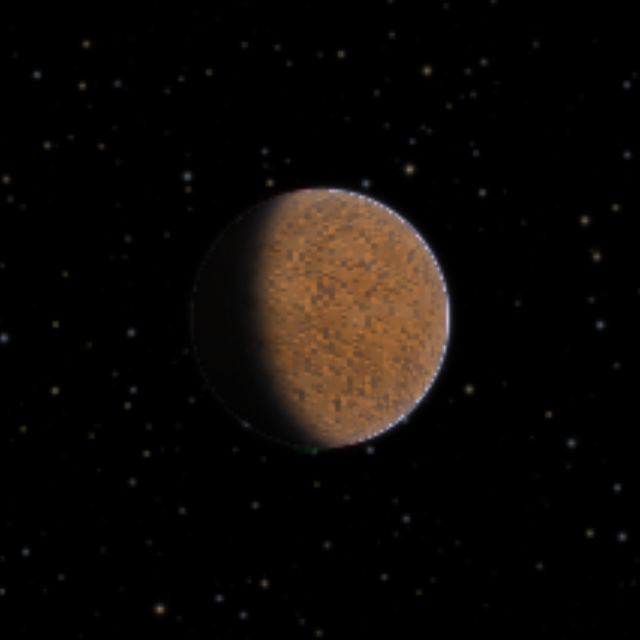
Tumba del Demiurgo
0
En este planeta árido y rocoso hay poco más que las ruinas que guardaban antiguos templos de civilizaciones de hace eones, conservadas de algún modo. Quizás este lugar tiene una fuerte conexión con el flujo del tiempo, por ser la tumba del Demiurgo
Rocky Terrestrial
✦ OuroborosLife possibleMagnetic FieldHigh Activity
Why is this a Rocky Terrestrial?
Your planet is dominated by silicate (8.5%) and iron (0.7%) content, forming a rocky terrestrial body.Rocky terrestrial planets are primarily composed of silicate rocks and metals. They're the most common type of small planet in the universe.
Classification Criteria:
✓ Silicon: 8.5% + Iron: 0.7% + Magnesium: 3.5%✓ Mass: 1.0x Earth (terrestrial range)
Habitability ScoreMarginal
Contributing Factors
water20
Very dry - minimal water
geology90
Active geology recycles nutrients and drives carbon cycle
rotation100
Optimal rotation period - balanced day/night cycle, moderate weather, and good heat distribution
Organic Chemistry100
All CHNOPS elements present - building blocks of life (tidal pools cycle wet and dry - a boost for prebiotic chemistry)
atmosphere50
CO₂ atmosphere with moderate greenhouse effect
temperature70
Challenging but potentially habitable temperature
magnetic Field100
Magnetic field provides radiation protection
Physical Properties
Mass
1.00x Earth (5.97e+24 kg)Radius
1.00x Earth (6,371 km)Surface Gravity
1.00x Earth (9.8 m/s²)Surface Temperature
340 K (67 °C / 153 °F)Rotation Period
24.0 hours/dayOrbital Environment
Star Type
M-type (Red Dwarf)Distance from Star
0.14 AU (20.9 million km)Orbital Period
35 daysAtmosphere
Thin CO₂ atmosphere
Elemental Composition
P - Phosphorus
23.4%
O - Oxygen
11.3%
Al - Aluminum
11.3%
Surface Characteristics
Rocky surface with impact craters, possible volcanic featuresClosest Real Exoplanet
Kepler-1649 b96% similar
Orbiting Kepler-1649| Yours | Kepler-1649 b | |
|---|---|---|
| Mass | 1.00 × Earth | 1.03 × Earth |
| Radius | 1.01 × Earth | 1.02 × Earth |
| Density (composition) | 5.30 g/cm³ | 5.35 g/cm³ |
| Temperature | 340.3 K | 307.0 K |
| Starlight received | 2.04 × Earth | 2.21 × Earth |
| Star temperature | 3,050 K | 3,240 K |
Moons
Moon 1stable0.00025% - 8.7 radii
Small and distant: a quiet, stable companion.
Moon 2stable0.010% - 14.9 radii
Small and distant: a quiet, stable companion.
Habitability
✓ Conditions could support lifeThis planet’s modelled conditions could support biological processes: stable temperatures, liquid water and the chemistry life as we know it needs. That makes life possible, not present.Love TerraForge? Please help support us.Keeps it ad-free, and funds new features and hosting.