Entering orbit…
AI assistant
Habitability
88/ 100
View planet
View star system
View surface
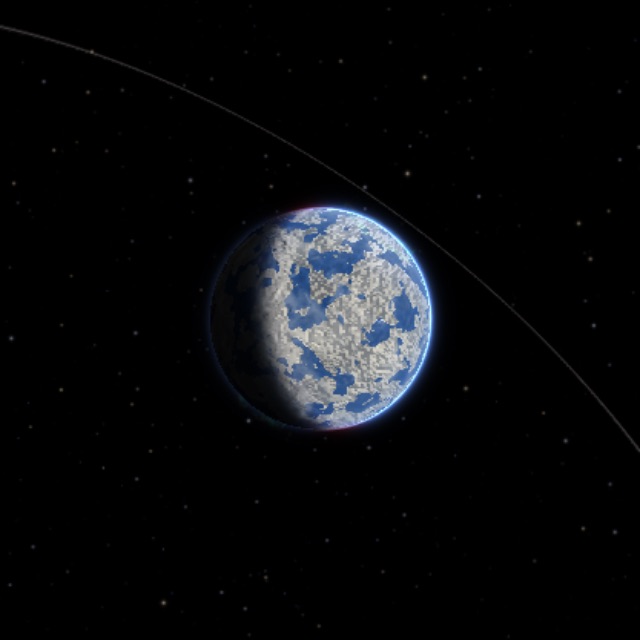
LEI 1 f
0
Exotic Terrestrial
✦ LEI 1Life possibleMagnetic FieldHigh Activity
Why is this a Exotic Terrestrial?Your planet builds its crust from exotic minerals (26.7% calcium/titanium/aluminum-family rock formers) instead of the silicate-iron recipe every standard rocky world uses.
Exotic terrestrials are temperate solid worlds whose geology skipped the silicate playbook - carbonate plains, titanium-gray mesas, alkali flats. They can hold air, water ingredients, and real habitability, but with no silicate continents or iron core they are their own class, not earth-likes.
Classification Criteria:
✓ Exotic rock formers: 26.7% (>=12% Ca/Ti/Al/K/Ni/U)✓ Standard rock: 0.0% (<15% - silicate rules never claimed it)✓ Temperature: 303K (240-380K temperate band)✓ Air + water ingredients: 51.7% O+H (>=15%) with an atmosphere
Habitability ScoreHighly Habitable
Contributing Factors
water100
Abundant water
geology90
Active geology recycles nutrients and drives carbon cycle
rotation65
Slow rotation - significant day/night temperature variations, but life can adapt
Organic Chemistry84
Core organic elements (CHNO) present (tidal pools cycle wet and dry - a boost for prebiotic chemistry)
atmosphere100
Nitrogen-oxygen atmosphere - breathable and protective
temperature100
Optimal temperature range for liquid water and life
magnetic Field100
Magnetic field provides radiation protection
Physical Properties
Mass
1.00x Earth (5.97e+24 kg)Radius
1.00x Earth (6,371 km)Surface Gravity
1.00x Earth (9.8 m/s²)Surface Temperature
303 K (30 °C / 85 °F)Rotation Period
24.0 hours/dayOrbital Environment
Star Type
G-type (Yellow (Sun-like))Distance from Star
1.30 AU (194 million km)Orbital Period
1.48 yearsAtmosphere
Nitrogen-oxygen atmosphere over exotic mineral flats
Elemental Composition
H - Hydrogen
28.3%
O - Oxygen
23.3%
Ca - Calcium
20.0%
Surface Characteristics
Pale mineral plains — carbonate flats, chalk mesas, and crusts no silicate world can buildClosest Real Exoplanet
Wolf 1069 b86% similar
Orbiting Wolf 1069| Yours | Wolf 1069 b | |
|---|---|---|
| Mass | 1.00 × Earth | 1.26 × Earth |
| Radius | 1.06 × Earth | 1.08 × Earth |
| Density (composition) | 4.60 g/cm³ | 5.51 g/cm³ |
| Temperature | 302.8 K | 250.0 K |
| Starlight received | 0.59 × Earth | 0.65 × Earth |
| Star temperature | 5,600 K | 3,158 K |
Moons
Moon 1rings0.00040% - 2.3 radii
Inside the Roche limit (2.80 planet radii): torn apart into a ring system.
Moon 2rings0.010% - 4.9 radii
Inside the synchronous orbit: it spiraled inward and was torn apart at the Roche limit (Phobos's fate).
Moon 3stableIce lost: bare rock0.032% - 17.9 radii
Small and distant: a quiet, stable companion.
Too warm for ice and too small to hold an atmosphere: the ice sublimated, leaving bare rock.