Entering orbit…
AI assistant
Habitability
30/ 100
View planet
View star system
View surface
marsbar
0
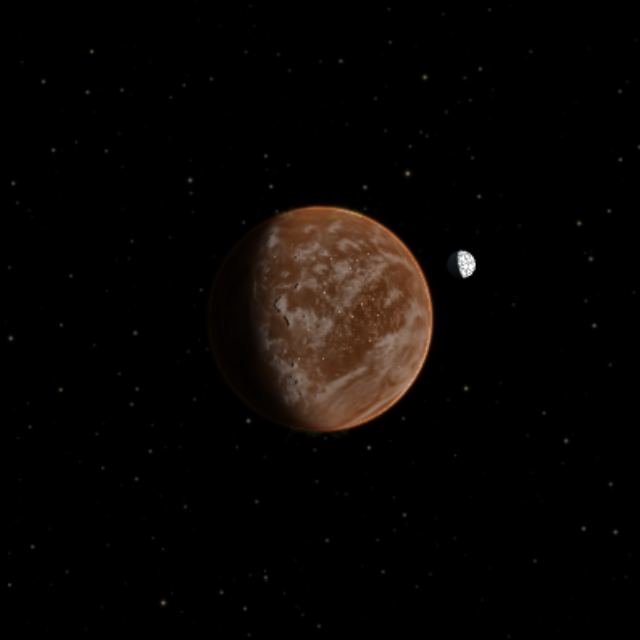
Carbon World
✦ josystemMagnetic FieldModerate Activity
Why is this a Carbon World?Your planet's carbon (26.8%) outweighs its oxygen (8.1%), so the mineralogy flips from silicate rock to carbide - a graphite crust over a diamond mantle.
Carbon worlds form in carbon-rich disks where there isn't enough oxygen to bind it all into silicates. Instead carbon condenses directly into graphite, carbides, and - under pressure at depth - diamond. They form water-poor, so no life takes hold.
Classification Criteria:
✓ Carbon: 26.8% (>=20% required)✓ Carbon exceeds Oxygen: 26.8% > 8.1%✓ Mass: 1.0x Earth (<=8x hycean ceiling)
Habitability ScoreExtremely Harsh
Contributing Factors
water64
Abundant water - likely as steam
geology90
Active geology recycles nutrients and drives carbon cycle
rotation30
Very slow rotation - extreme temperature swings between eternal day and night sides
Organic Chemistry54
Carbon and hydrogen present - organic chemistry possible (tidal pools cycle wet and dry - a boost for prebiotic chemistry)
atmosphere40
Atmosphere present but composition not ideal for life
temperature15
Extremely hot - hostile to known life forms
magnetic Field100
Magnetic field provides radiation protection
Physical Properties
Mass
1.00x Earth (5.97e+24 kg)Radius
1.00x Earth (6,371 km)Surface Gravity
1.00x Earth (9.8 m/s²)Surface Temperature
469 K (196 °C / 384 °F)Rotation Period
24.0 hours/dayOrbital Environment
Star Type
G-type (Yellow (Sun-like))Distance from Star
1.27 AU (190 million km)Orbital Period
1.43 yearsAtmosphere
Carbon monoxide and methane haze over a graphite surface
Elemental Composition
H - Hydrogen
59.7%
C - Carbon
26.8%
O - Oxygen
8.1%
Surface Characteristics
Graphite plains and carbide ridges over a diamond mantle - a glittering coal-black worldClosest Real Exoplanet
Wolf 1069 b78% similar
Orbiting Wolf 1069| Yours | Wolf 1069 b | |
|---|---|---|
| Mass | 1.00 × Earth | 1.26 × Earth |
| Radius | 1.12 × Earth | 1.08 × Earth |
| Density (composition) | 3.90 g/cm³ | 5.51 g/cm³ |
| Temperature | 468.7 K | 250.0 K |
| Starlight received | 0.62 × Earth | 0.65 × Earth |
| Star temperature | 5,600 K | 3,158 K |
Moons
Moon 1receding10% - 94.0 radii
Outside the synchronous orbit: slowly receding, like Luna (~cm per year).