Entering orbit…
AI assistant
Habitability
0/ 100
View planet
View star system
View surface
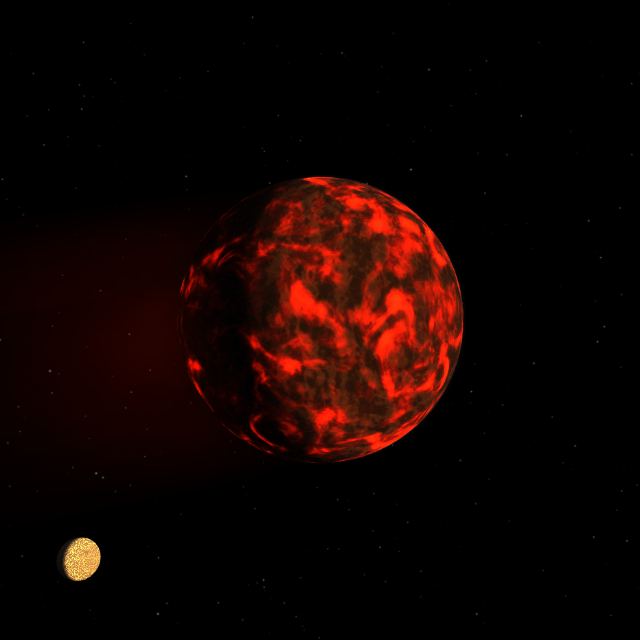
Honos
0
Lava World
✦ MutaMagnetic FieldExtreme Activity
Why is this a Lava World?Your planet's proximity to its star (0.20 AU) results in extreme surface temperatures of 2780K.
Lava worlds orbit so close to their stars that rocky surfaces melt into oceans of molten rock. Recent planet formation can also create temporary lava worlds.
Classification Criteria:
✓ Temperature: 2780K (>1000K)
Habitability ScoreUninhabitable
Contributing Factors
water0
No water - the recipe has no hydrogen and oxygen to form it
geology40
Extreme volcanic activity may be hazardous
rotation65
Slow rotation - significant day/night temperature variations, but life can adapt
Organic Chemistry20
Limited organic chemistry potential
atmosphere10
No atmosphere - exposed to radiation and temperature extremes
temperature0
Inferno world - temperatures exceed all possibility of life
magnetic Field100
Magnetic field provides radiation protection
Physical Properties
Mass
0.70x Earth (4.18e+24 kg)Radius
0.89x Earth (5,657 km)Surface Gravity
0.89x Earth (8.7 m/s²)Surface Temperature
2,780 K (2,507 °C / 4,544 °F)Rotation Period
12.0 hours/day (faster than Earth)Orbital Environment
Star Type
BH-type (Black Hole)Distance from Star
0.20 AU (29.9 million km)Orbital Period
10 daysTime Dilation
Clocks run 23.4 seconds per year slower than deep space — about 31 minutes over a lifetimeAtmosphere
Minimal - too hot to retain
Elemental Composition
O - Oxygen
23.0%
Si - Silicon
23.0%
Fe - Iron
17.2%
Surface Characteristics
Molten surface with lava flows, volcanic activity everywhereClosest Real Exoplanet
Kepler-1547 b86% similar
Orbiting Kepler-1547| Yours | Kepler-1547 b | |
|---|---|---|
| Mass | 0.70 × Earth | 0.67 × Earth |
| Radius | 0.91 × Earth | 0.90 × Earth |
| Density (composition) | 5.14 g/cm³ | 5.03 g/cm³ |
| Temperature | 2,780 K | 3,186 K |
| Starlight received | 10,000 × Earth | 5,760 × Earth |
| Star temperature | — | 6,078 K |
Moons
Moon 1stable0.00056% - 4.4 radii
Small and distant: a quiet, stable companion.
Moon 2stable0.0020% - 6.2 radii
Small and distant: a quiet, stable companion.