Entering orbit…
AI assistant
Habitability
5/ 100
View planet
View star system
View surface
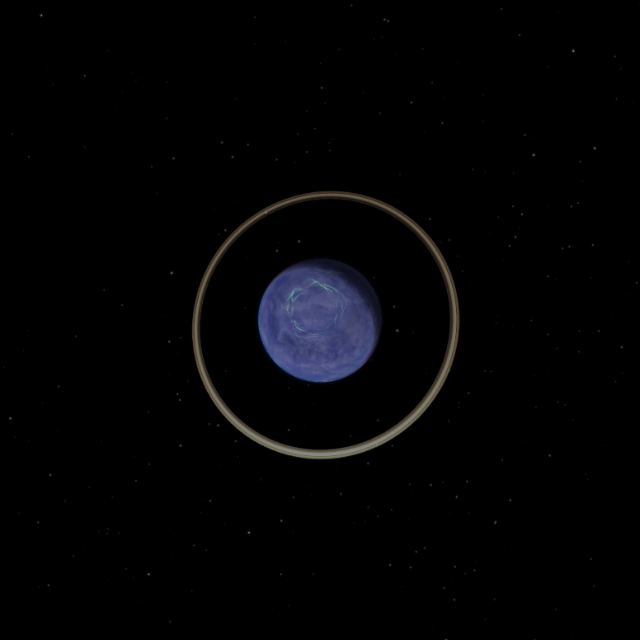
RS-037-973-937-842-385-271
0
Ne
Gas Giant
✦ D-005Magnetic FieldExtreme Activity
Why is this a Gas Giant?Your planet has 63.5% hydrogen and helium, combined with a mass of 38.0x Earth, which exceeds the gas giant threshold.
Gas giants form when massive cores capture enormous atmospheres of light gases. They typically form beyond the 'frost line' where volatiles can condense.
Classification Criteria:
✓ Hydrogen + Helium: 63.5% (>60% required)✓ Mass: 38.0x Earth (>10x required)
Habitability ScoreUninhabitable
Contributing Factors
water15
No solid surface — any water is locked in a supercritical mantle and hot ice, not oceans
geology40
Extreme volcanic activity may be hazardous
rotation100
Optimal rotation period - balanced day/night cycle, moderate weather, and good heat distribution
Organic Chemistry80
Core organic elements (CHNO) present
atmosphere30
Hydrogen-rich atmosphere typical of gas giants
temperature15
Extremely hot - hostile to known life forms
magnetic Field100
Magnetic field provides radiation protection — but the black hole's accretion disk bathes this orbit in hard X-ray radiation
Physical Properties
Mass
38.00x Earth (2.27e+26 kg)Radius
3.36x Earth (21,419 km)Surface Gravity
3.36x Earth (33.0 m/s²)Surface Temperature
573 K (300 °C / 572 °F)Rotation Period
22.0 hours/day (faster than Earth)Orbital Environment
Star Type
BH-type (Black Hole)Distance from Star
10.50 AU (1.57 billion km)Orbital Period
10.8 yearsAtmosphere
Hydrogen and helium dominated with trace methane and ammonia
Elemental Composition
H - Hydrogen
39.1%
He - Helium
24.3%
C - Carbon
14.8%
Surface Characteristics
No solid surface - thick gaseous envelope with possible rocky core deep withinClosest Real Exoplanet
TOI-1410 c82% similar
Orbiting TOI-1410| Yours | TOI-1410 c | |
|---|---|---|
| Mass | 38.0 × Earth | 27.0 × Earth |
| Radius | 5.44 × Earth | 5.63 × Earth |
| Density (composition) | 1.30 g/cm³ | 0.83 g/cm³ |
| Temperature | 573.2 K | 397.0 K |
| Starlight received | 3.63 × Earth | 4.18 × Earth |
| Star temperature | — | 4,635 K |
Moons
Moon 1rings0.010% - 2.2 radii
Inside the synchronous orbit: it spiraled inward and was torn apart at the Roche limit (Phobos's fate).