Entering orbit…
AI assistant
Habitability
10/ 100
View planet
View star system
View surface
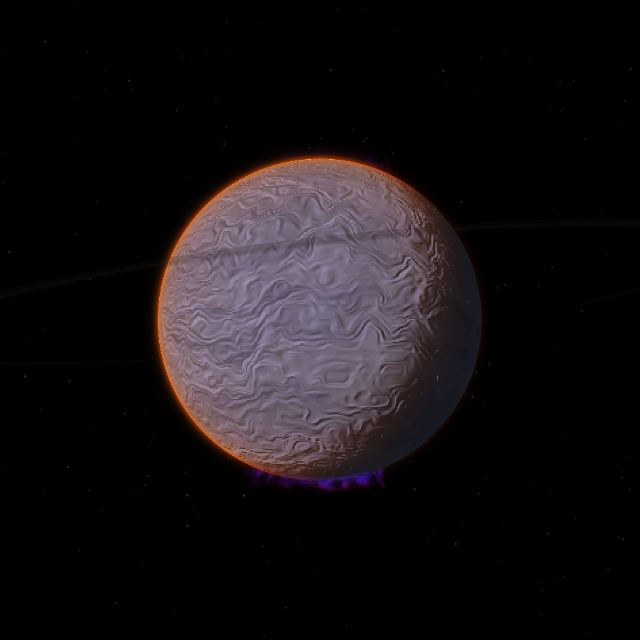
Warm-tune
- Mass
- 72.00 × Earth
- Radius
- 4.16 × Earth
- Gravity
- 4.16 g
- Surface
- 593 K
- Year
- 119 days
- Day
- 14.0 hrs
- Mass
- 72.00 × Earth
- Radius
- 4.16 × Earth
- Gravity
- 4.16 g
- Surface
- 593 K
- Year
- 119 days
- Day
- 14.0 hrs
Warm-tune's star
K-type · Orange
Warm-tune0.42 AUSub-NeptuneYou are hereHabitable zone
Star and planet drawn to scale (a typical star of its class), with only the star's edge in view. Orbits spaced as in the star system view.
Warm-tune's moons
1 moon
Moon 2Rock · 134,900 km
Planet, moons and orbits drawn to one scale; the smallest moons are enlarged so they can be seen.
This is the most common type of exoplanets we have discovered. warm sub Neptune's or mini neptunes that orbit close to their star.
Surface. No solid surface - a thick gas envelope wrapped around a small deep core (a mini-Neptune)
Sub-Neptune
Magnetic FieldLow Activity
Sub-Neptunes are the most common planets Kepler found, though our own solar system has none. Too light to be a giant, they still hold on to a thick envelope of light gas over a rocky or icy core.
Classification Criteria:
✓ Mass: 72.0x Earth (under 20x, below the giants)✓ A hydrogen-helium envelope over the core
Habitability ScoreUninhabitable
Contributing Factors
water15
No solid surface — any water is locked in a supercritical mantle and hot ice, not oceans
geology60
Some geological activity provides slow nutrient cycling
rotation100
Optimal rotation period - balanced day/night cycle, moderate weather, and good heat distribution
Organic Chemistry84
Core organic elements (CHNO) present (tidal pools cycle wet and dry - a boost for prebiotic chemistry)
atmosphere30
Deep hydrogen-helium envelope with photochemical haze
Hydrogen-rich atmosphere typical of gas giantstemperature5
Extremely hot - hostile to known life forms
magnetic Field100
Magnetic field provides radiation protection
Physical Properties
Mass
72.00x Earth (4.30e+26 kg)Radius
4.16x Earth (26,504 km)Surface Gravity
4.16x Earth (40.8 m/s²)Surface Temperature
593 K (320 °C / 608 °F)Rotation Period
14.0 hours/day (faster than Earth)Elemental Composition
Closest Real Exoplanet
Kepler-103 c76% similar
Orbiting Kepler-103| Yours | Kepler-103 c | |
|---|---|---|
| Mass | 72.0 × Earth | 58.5 × Earth |
| Radius | 6.28 × Earth | 5.45 × Earth |
| Density (composition) | 1.60 g/cm³ | 1.99 g/cm³ |
| Temperature | 593.1 K | 434.0 K |
| Starlight received | 2.27 × Earth | 5.97 × Earth |
| Star temperature | 4,450 K | 6,047 K |
Moons
Moon 1rings
Inside the synchronous orbit: it spiraled inward and was torn apart at the Roche limit (Phobos's fate).
Moon 2stable
Small and distant: a quiet, stable companion.
+4 chemistry: tidal pools cycle wet and dry - a boost for prebiotic chemistry