Entering orbit…
AI assistant
Habitability
22/ 100
View planet
View star system
View surface
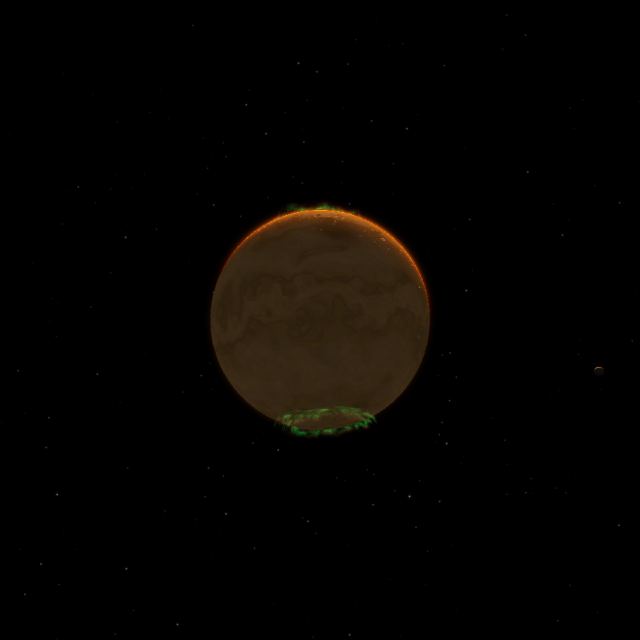
Urken
0
Took many gases from its home star since both the star and the planet formed during the exact same time, but the star had much more gravity which pulled some of the gasses away from the newly formed planet
Gas Dwarf
✦ UrsonfallMagnetic FieldLow Activity
Why is this a Gas Dwarf?Your planet has an unusual composition that doesn't fit standard classifications, or lacks the elements needed for complex geological processes.
Barren worlds can form from uncommon element combinations or may be remnants of larger bodies that lost their atmospheres and volatile materials.
Classification Criteria:
Composition doesn't match standard planet typesMass: 4.3x EarthTemperature: 393K
Habitability ScoreExtremely Harsh
Contributing Factors
water15
No solid surface — any water is locked in a supercritical mantle and hot ice, not oceans
geology60
Some geological activity provides slow nutrient cycling
rotation60
Fast rotation - strong global wind patterns and weather systems, but manageable
Organic Chemistry50
Carbon and hydrogen present - organic chemistry possible
atmosphere30
Hydrogen-rich atmosphere typical of gas giants
temperature40
Extreme temperature - very difficult for life (strong seasons from a 49° tilt: −3% habitability)
magnetic Field100
Magnetic field provides radiation protection
Physical Properties
Mass
4.30x Earth (2.57e+25 kg)Radius
1.63x Earth (10,360 km)Surface Gravity
1.63x Earth (16.0 m/s²)Surface Temperature
393 K (120 °C / 248 °F)Rotation Period
10.0 hours/day (faster than Earth)Orbital Environment
Star Type
M-type (Red Dwarf)Distance from Star
0.10 AU (15 million km)Orbital Period
21 daysAtmosphere
Deep hydrogen-helium envelope with photochemical haze
Elemental Composition
H - Hydrogen
54.6%
He - Helium
26.1%
O - Oxygen
10.3%
Surface Characteristics
No solid surface - a thick gas envelope wrapped around a small deep core (a mini-Neptune)Closest Real Exoplanet
TOI-1266 b95% similar
Orbiting TOI-1266| Yours | TOI-1266 b | |
|---|---|---|
| Mass | 4.30 × Earth | 4.46 × Earth |
| Radius | 2.46 × Earth | 2.52 × Earth |
| Density (composition) | 1.60 g/cm³ | 1.54 g/cm³ |
| Temperature | 393.2 K | 415.0 K |
| Starlight received | 4.00 × Earth | 4.72 × Earth |
| Star temperature | 3,050 K | 3,563 K |
Moons
Moon 1stable0.00010% - 5.4 radii
Small and distant: a quiet, stable companion.
Moon 2stable0.00010% - 14.0 radii
Small and distant: a quiet, stable companion.