Entering orbit…
AI assistant
Habitability
13/ 100
View planet
View star system
View surface
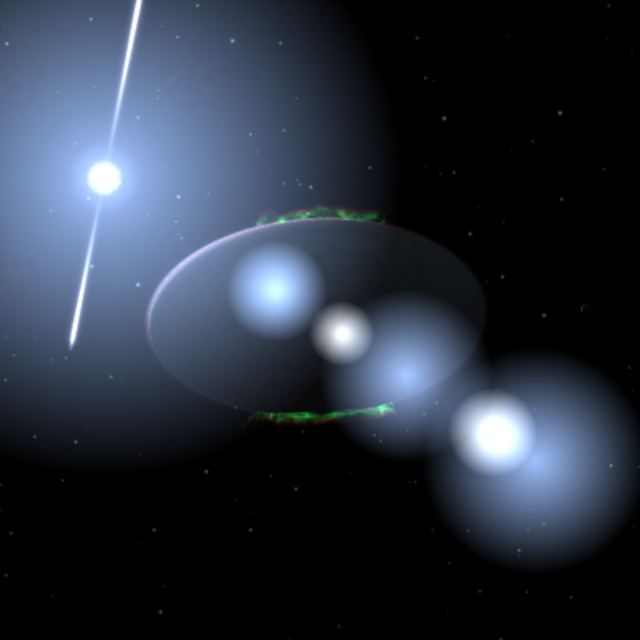
Blin
0
Planet have one moon with name: Skandal, On this planet life is possible (on blin).
Barren
Life possibleMagnetic FieldHigh Activity
Why is this a Barren?
Your planet has an unusual composition that doesn't fit standard classifications, or lacks the elements needed for complex geological processes.Barren worlds can form from uncommon element combinations or may be remnants of larger bodies that lost their atmospheres and volatile materials.
Classification Criteria:
Composition doesn't match standard planet typesMass: 4.6x EarthTemperature: 336K
Habitability ScoreUninhabitable
Contributing Factors
water30
Abundant water (water stripped by extreme rotation)
geology90
Active geology recycles nutrients and drives carbon cycle
rotation5
Extreme rotation (< 4 hrs) - winds exceeding 1000 mph, constant category 5 hurricanes, uninhabitable surface
Organic Chemistry25
Carbon and hydrogen present - organic chemistry possible - chlorine-laced environment attacks organic molecules
atmosphere15
CO₂ atmosphere with moderate greenhouse effect (severely compromised by extreme rotation)
temperature70
Challenging but potentially habitable temperature
magnetic Field100
Magnetic field provides radiation protection — but the pulsar's beams bathe this orbit in hard X-rays
Physical Properties
Mass
4.60x Earth (2.75e+25 kg)Radius
1.66x Earth (10,596 km)Surface Gravity
1.66x Earth (16.3 m/s²)Surface Temperature
336 K (62 °C / 144 °F)Rotation Period
2.0 hours/day (faster than Earth)Orbital Environment
Star Type
NS-type (Neutron Star)Distance from Star
0.10 AU (15 million km)Orbital Period
10 daysTime Dilation
Clocks run 6.5 seconds per year slower than deep space — about 9 minutes over a lifetimeAtmosphere
Thin CO₂ atmosphere
Elemental Composition
H - Hydrogen
35.9%
O - Oxygen
23.1%
Cl - Chlorine
17.9%
Surface Characteristics
Barren rocky surface with unusual elemental compositionClosest Real Exoplanet
TOI-1452 b85% similar
Orbiting TOI-1452| Yours | TOI-1452 b | |
|---|---|---|
| Mass | 4.60 × Earth | 4.82 × Earth |
| Radius | 1.53 × Earth | 1.67 × Earth |
| Density (composition) | 7.08 g/cm³ | 5.70 g/cm³ |
| Temperature | 335.5 K | 326.0 K |
| Starlight received | 1.00 × Earth | 1.80 × Earth |
| Star temperature | — | 3,185 K |
Moons
Moon 1stableIce lost: bare rock0.00010% - 8.4 radii
Small and distant: a quiet, stable companion.
Too warm for ice and too small to hold an atmosphere: the ice sublimated, leaving bare rock.
Habitability
✓ Conditions could support lifeThis planet’s modelled conditions could support biological processes: stable temperatures, liquid water and the chemistry life as we know it needs. That makes life possible, not present.Love TerraForge? Please help support us.Keeps it ad-free, and funds new features and hosting.