Entering orbit…
AI assistant
Habitability
51/ 100
View planet
View star system
View surface
Esp
0
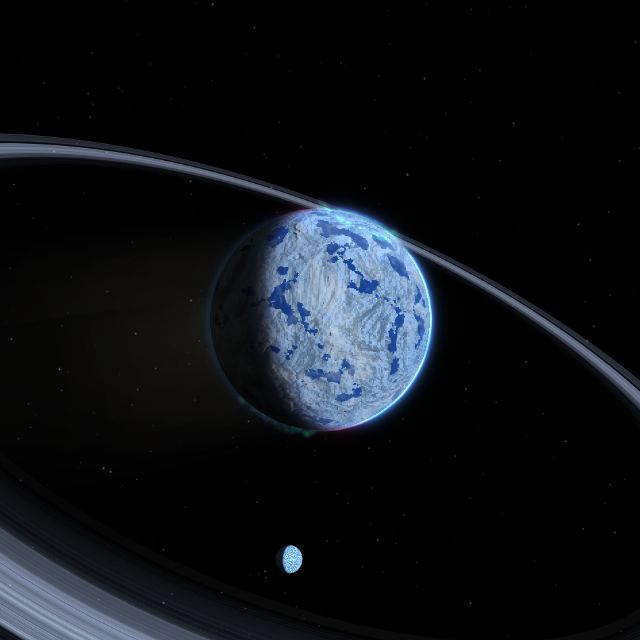
Exotic Terrestrial
✦ OloumLife DetectedMagnetic FieldModerate Activity
Why is this a Exotic Terrestrial?Your planet builds its crust from exotic minerals (17.9% calcium/titanium/aluminum-family rock formers) instead of the silicate-iron recipe every standard rocky world uses.
Exotic terrestrials are temperate solid worlds whose geology skipped the silicate playbook - carbonate plains, titanium-gray mesas, alkali flats. They can hold air, water ingredients, and real habitability, but with no silicate continents or iron core they are their own class, not earth-likes.
Classification Criteria:
✓ Exotic rock formers: 17.9% (>=12% Ca/Ti/Al/K/Ni/U)✓ Standard rock: 14.7% (<15% - silicate rules never claimed it)✓ Temperature: 296K (240-380K temperate band)✓ Air + water ingredients: 29.5% O+H (>=15%) with an atmosphere
Habitability ScoreMarginal
Contributing Factors
water90
Good water content (low gravity lets water escape to space)
geology90
Active geology recycles nutrients and drives carbon cycle
rotation100
Optimal rotation period - balanced day/night cycle, moderate weather, and good heat distribution
Organic Chemistry80
Core organic elements (CHNO) present
atmosphere100
Nitrogen-oxygen atmosphere - breathable and protective
temperature100
Optimal temperature range for liquid water and life
magnetic Field100
Magnetic field provides radiation protection — but the pulsar's beams bathe this orbit in hard X-rays
Physical Properties
Mass
0.70x Earth (4.18e+24 kg)Radius
0.89x Earth (5,657 km)Surface Gravity
0.89x Earth (8.7 m/s²)Surface Temperature
296 K (23 °C / 74 °F)Rotation Period
16.0 hours/day (faster than Earth)Orbital Environment
Star Type
NS-type (Neutron Star)Distance from Star
0.13 AU (19.4 million km)Orbital Period
14 daysTime Dilation
Clocks run 5.0 seconds per year slower than deep space — about 7 minutes over a lifetimeAtmosphere
Nitrogen-oxygen atmosphere over exotic mineral flats
Elemental Composition
O - Oxygen
17.9%
N - Nitrogen
12.6%
C - Carbon
11.6%
Surface Characteristics
Pale mineral plains — carbonate flats, chalk mesas, and crusts no silicate world can buildClosest Real Exoplanet
TRAPPIST-1 e93% similar
Orbiting TRAPPIST-1| Yours | TRAPPIST-1 e | |
|---|---|---|
| Mass | 0.70 × Earth | 0.69 × Earth |
| Radius | 0.96 × Earth | 0.92 × Earth |
| Density (composition) | 4.30 g/cm³ | 4.90 g/cm³ |
| Temperature | 296.3 K | 250.0 K |
| Starlight received | 0.59 × Earth | 0.65 × Earth |
| Star temperature | — | 2,566 K |
Moons
Moon 1rings0.0032% - 4.4 radii
Inside the synchronous orbit: it spiraled inward and was torn apart at the Roche limit (Phobos's fate).
Moon 2rings0.89% - 2.6 radii
Inside the Roche limit (2.80 planet radii): torn apart into a ring system.
Moon 3stable0.00071% - 10.9 radii
Small and distant: a quiet, stable companion.