Entering orbit…
AI assistant
Habitability
66/ 100
View planet
View star system
View surface
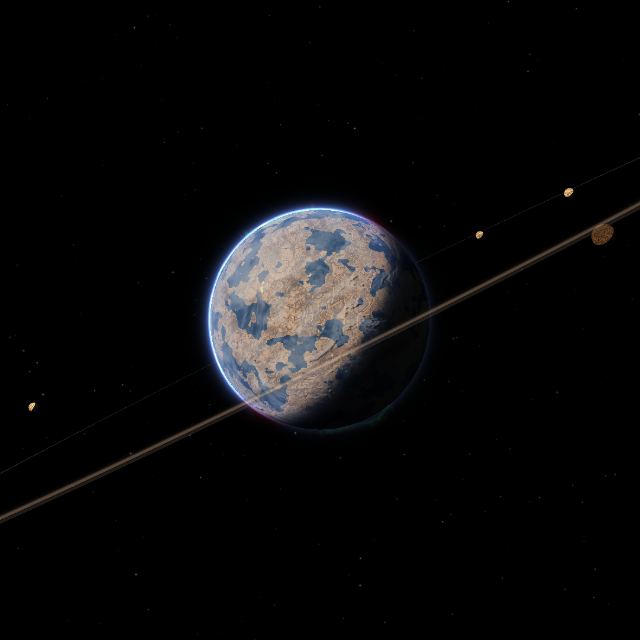
blanet
- Mass
- 1.00 × Earth
- Radius
- 1.00 × Earth
- Gravity
- 1.00 g
- Surface
- 319 K
- Year
- 44.4 years
- Day
- 24.0 hrs
- Mass
- 1.00 × Earth
- Radius
- 1.00 × Earth
- Gravity
- 1.00 g
- Surface
- 319 K
- Year
- 44.4 years
- Day
- 24.0 hrs
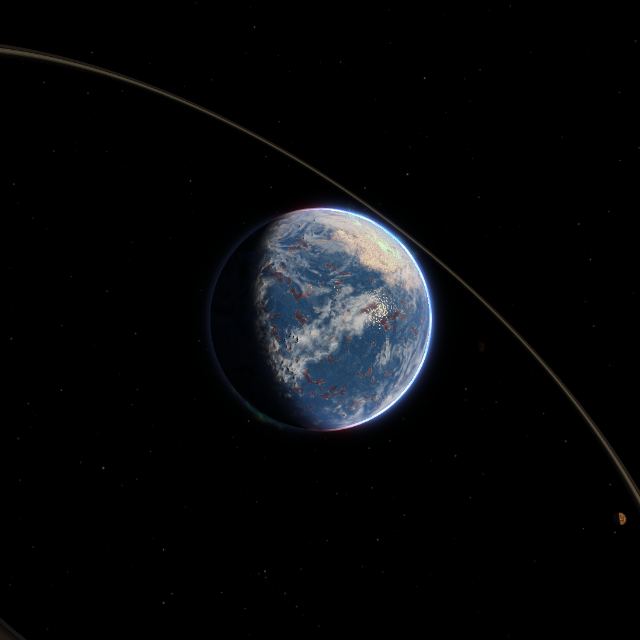
Habitable zone
Star and planets drawn to scale (a typical star of its class), with only the star's edge in view. Orbits spaced as in the star system view.
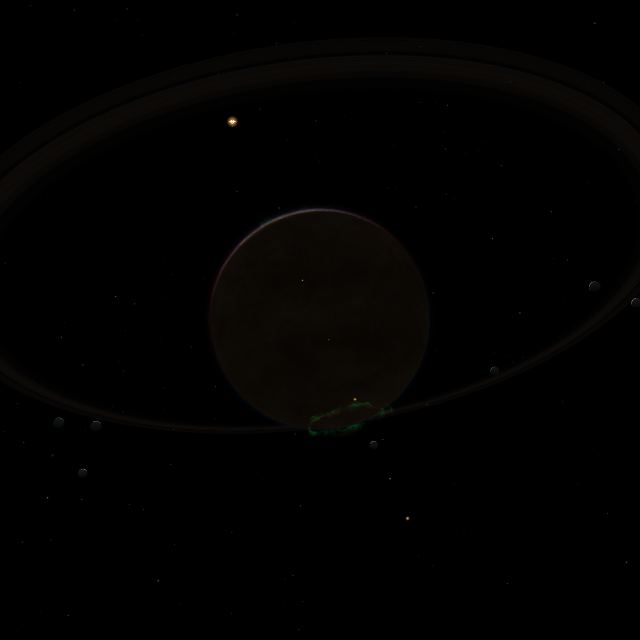
blanet's moons
5 moons
Moon 5Rock · 46,900 km
Moon 7Ice · 72,000 km
Moon 8Ice · 109,600 km
Moon 9Ice · 166,900 km
Moon 10Ice · 254,200 km
Planet, moons and orbits drawn to one scale; the smallest moons are enlarged so they can be seen.
Surface. Pale mineral plains — carbonate flats, chalk mesas, and crusts no silicate world can build
Exotic Terrestrial
✦ black hole
Your planet builds its crust from exotic minerals (34.1% calcium/titanium/aluminum-family rock formers) instead of the silicate-iron recipe every standard rocky world uses.Life unlikely — no phosphorus — DNA and ATP are built on itMagnetic FieldHigh Activity
Exotic terrestrials are temperate solid worlds whose geology skipped the silicate playbook - carbonate plains, titanium-gray mesas, alkali flats. They can hold air, water ingredients, and real habitability, but with no silicate continents or iron core they are their own class, not earth-likes.
Classification Criteria:
✓ Exotic rock formers: 34.1% (>=12% Ca/Ti/Al/K/Ni/U)✓ Standard rock: 0.0% (<15% - silicate rules never claimed it)✓ Temperature: 319K (240-380K temperate band)✓ Air + water ingredients: 41.8% O+H (>=15%) with an atmosphere
Habitability ScoreHabitable
Contributing Factors
water100
Abundant water
geology90
Active geology recycles nutrients and drives carbon cycle
rotation65
Slow rotation - significant day/night temperature variations, but life can adapt
Organic Chemistry84
Core organic elements (CHNO) present (tidal pools cycle wet and dry - a boost for prebiotic chemistry)
atmosphere100
Nitrogen-oxygen atmosphere over exotic mineral flats
Nitrogen-oxygen atmosphere - breathable and protectivetemperature70
Challenging but potentially habitable temperature
magnetic Field100
Magnetic field provides radiation protection — but the black hole's accretion disk bathes this orbit in hard X-ray radiation
Physical Properties
Mass
1.00x Earth (5.97e+24 kg)Radius
1.00x Earth (6,371 km)Surface Gravity
1.00x Earth (9.8 m/s²)Surface Temperature
319 K (46 °C / 115 °F)Rotation Period
24.0 hours/dayElemental Composition
Closest Real Exoplanet
Wolf 1069 b88% similar
Orbiting Wolf 1069| Yours | Wolf 1069 b | |
|---|---|---|
| Mass | 1.00 × Earth | 1.26 × Earth |
| Radius | 1.06 × Earth | 1.08 × Earth |
| Density (composition) | 4.60 g/cm³ | 5.51 g/cm³ |
| Temperature | 319.4 K | 250.0 K |
| Starlight received | 0.55 × Earth | 0.65 × Earth |
| Star temperature | — | 3,158 K |
Moons
Moon 1merged
Merged with an adjacent moon: too close for both to hold a stable orbit.
Moon 2rings
Inside the synchronous orbit: it spiraled inward and was torn apart at the Roche limit (Phobos's fate).
Moon 3rings
Inside the Roche limit (2.80 planet radii): torn apart into a ring system.
Moon 4rings
Inside the Roche limit (2.80 planet radii): torn apart into a ring system.
Moon 5stableIce lost: bare rock
Small and distant: a quiet, stable companion.
Too warm for nitrogen and methane frost and too small to hold them as an atmosphere: those ices escaped to space, leaving water ice.
Too warm for ice and too small to hold an atmosphere: the ice sublimated, leaving bare rock.
Moon 6rings
Inside the Roche limit (2.80 planet radii): torn apart into a ring system.
Moon 7stable
Small and distant: a quiet, stable companion.
Moon 8stable
Small and distant: a quiet, stable companion.
Moon 9stable
Small and distant: a quiet, stable companion.
Moon 10stable
Small and distant: a quiet, stable companion.
+4 chemistry: tidal pools cycle wet and dry - a boost for prebiotic chemistry