Entering orbit…
AI assistant
Habitability
52/ 100
View planet
View star system
View surface
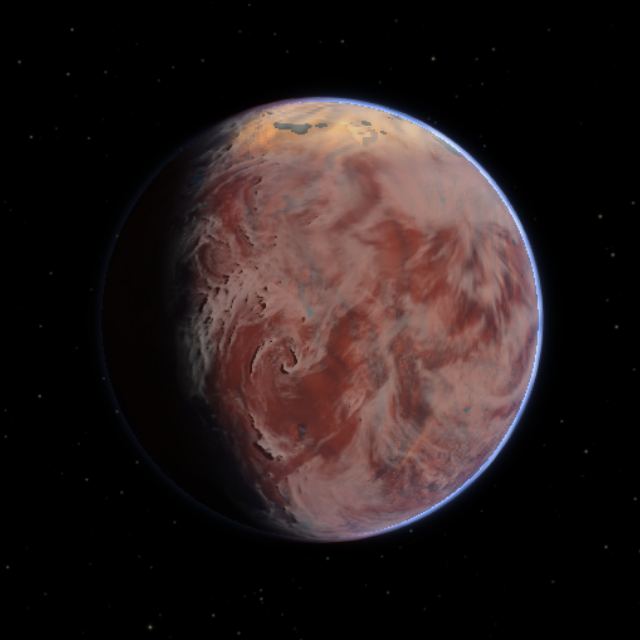
HSG 582 e
0
HSG 582 e is a more dull, iron-rich planet with a thin atmosphere composed of mainly nitrogen and a small amount of oxygen. It has a small amount of liquid water, and hosts small, unicellular life in subterranean lakes and caves.
Rocky Terrestrial
✦ HSG 582Life possibleModerate Activity
Why is this a Rocky Terrestrial?
Your planet is dominated by silicate (30.3%) and iron (15.2%) content, forming a rocky terrestrial body.Rocky terrestrial planets are primarily composed of silicate rocks and metals. They're the most common type of small planet in the universe.
Classification Criteria:
✓ Silicon: 30.3% + Iron: 15.2% + Magnesium: 4.5%✓ Mass: 1.5x Earth (terrestrial range)
Habitability ScoreMarginal
Contributing Factors
water79
Good water content - mostly frozen
geology90
Active geology recycles nutrients and drives carbon cycle
rotation10
Near tidally locked - one hemisphere perpetually scorched, other frozen, narrow habitable twilight zone only
Organic Chemistry100
All CHNOPS elements present - building blocks of life
atmosphere28
Nitrogen atmosphere provides protection but not breathable (partially stripped by slow rotation)
temperature70
Challenging but potentially habitable temperature
magnetic Field30
No magnetic field - vulnerable to solar radiation
Physical Properties
Mass
1.50x Earth (8.96e+24 kg)Radius
1.14x Earth (7,293 km)Surface Gravity
1.14x Earth (11.2 m/s²)Surface Temperature
259 K (-14 °C / 6 °F)Rotation Period
1,221.0 hours/day (slower than Earth)Orbital Environment
Star Type
M-type (Red Dwarf)Distance from Star
0.26 AU (38.9 million km)Orbital Period
88 daysAtmosphere
Thin CO₂ and nitrogen atmosphere
Elemental Composition
Si - Silicon
30.3%
N - Nitrogen
15.2%
Fe - Iron
15.2%
Surface Characteristics
Rocky surface with impact craters, possible volcanic featuresClosest Real Exoplanet
GJ 1061 d96% similar
Orbiting GJ 1061| Yours | GJ 1061 d | |
|---|---|---|
| Mass | 1.50 × Earth | 1.67 × Earth |
| Radius | 1.13 × Earth | 1.16 × Earth |
| Density (composition) | 5.72 g/cm³ | 5.90 g/cm³ |
| Temperature | 258.9 K | 242.0 K |
| Starlight received | 0.59 × Earth | 0.60 × Earth |
| Star temperature | 3,050 K | 2,953 K |
Habitability
✓ Conditions could support lifeThis planet’s modelled conditions could support biological processes: stable temperatures, liquid water and the chemistry life as we know it needs. That makes life possible, not present.Love TerraForge? Please help support us.Keeps it ad-free, and funds new features and hosting.