Entering orbit…
AI assistant
Habitability
16/ 100
View planet
View star system
View surface
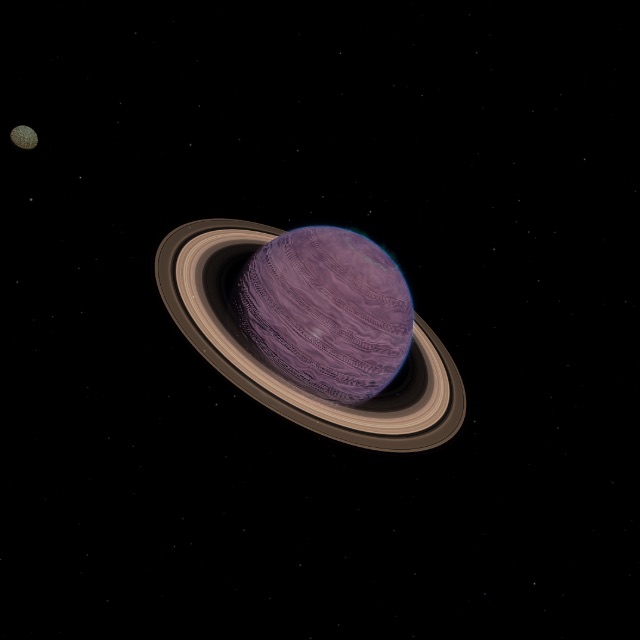
Kargam
Ice Giant
- Mass
- 9.00 × Earth
- Radius
- 2.08 × Earth
- Gravity
- 2.08 g
- Surface
- 149 K
- Year
- 6.8 years
- Day
- 12.0 hrs
- Mass
- 9.00 × Earth
- Radius
- 2.08 × Earth
- Gravity
- 2.08 g
- Surface
- 149 K
- Year
- 6.8 years
- Day
- 12.0 hrs
Kargam's star
K-type · Orange
Kargam3.20 AUIce GiantYou are hereHabitable zone
Star and planet drawn to scale (a typical star of its class), with only the star's edge in view. Orbits spaced as in the star system view.
Kargam's moons
1 moon
Moon 3Ocean · 121,600 km
Planet, moons and orbits drawn to one scale; the smallest moons are enlarged so they can be seen.
This is Kargam. only 500 million years after the system formed. its moon Sha used to be a water world
Surface. Icy mantle surrounding rocky core, with hydrogen-helium atmosphere
Ice Giant
Magnetic FieldModerate Activity
Ice giants like Uranus and Neptune have icy interiors with thick atmospheres of hydrogen and helium, but not enough to be classified as gas giants.
Classification Criteria:
✓ Mass: 9.0x Earth (5-20x range)✓ Water/Carbon/Nitrogen rich composition
Habitability ScoreUninhabitable
Contributing Factors
water15
No solid surface — any water is locked in a supercritical mantle and hot ice, not oceans
geology90
Active geology recycles nutrients and drives carbon cycle
rotation10
Near tidally locked - one hemisphere perpetually scorched, other frozen, narrow habitable twilight zone only
Organic Chemistry84
Core organic elements (CHNO) present (tidal pools cycle wet and dry - a boost for prebiotic chemistry)
atmosphere12
Hydrogen and helium with water, methane, and ammonia ices
Hydrogen-rich atmosphere typical of gas giants (partially stripped by slow rotation)temperature20
Very cold - water frozen, challenging for life (strong seasons from a 48° tilt: −3% habitability)
magnetic Field100
Magnetic field provides radiation protection
Physical Properties
Mass
9.00x Earth (5.37e+25 kg)Radius
2.08x Earth (13,252 km)Surface Gravity
2.08x Earth (20.4 m/s²)Surface Temperature
149 K (-124 °C / -191 °F)Rotation Period
12.0 hours/day (faster than Earth)Elemental Composition
Closest Real Exoplanet
Wolf 1061 d85% similar
Orbiting Wolf 1061| Yours | Wolf 1061 d | |
|---|---|---|
| Mass | 9.00 × Earth | 7.70 × Earth |
| Radius | 3.14 × Earth | 2.69 × Earth |
| Density (composition) | 1.60 g/cm³ | 2.18 g/cm³ |
| Temperature | 149.3 K | 130.0 K |
| Starlight received | 0.04 × Earth | 0.06 × Earth |
| Star temperature | 4,450 K | 3,342 K |
Moons
Moon 1rings
Inside the Roche limit (1.92 planet radii): torn apart into a ring system.
Moon 2merged
Merged with an adjacent moon: too close for both to hold a stable orbit.
Moon 3recedingOcean world
Outside the synchronous orbit: slowly receding, like Luna (~cm per year).
Tidal braking locked the planet to its moon: one face forever moonward.
A thin tidal-warmed subsurface ocean may exist, but conditions are marginal (37/100).
+4 chemistry: tidal pools cycle wet and dry - a boost for prebiotic chemistry