Entering orbit…
AI assistant
Habitability
60/ 100
View planet
View star system
View surface
Watrel
0
- Mass
- 0.50 × Earth
- Radius
- 0.79 × Earth
- Gravity
- 0.79 g
- Surface
- 276 K
- Year
- 523 days
- Day
- 26.0 hrs
- Mass
- 0.50 × Earth
- Radius
- 0.79 × Earth
- Gravity
- 0.79 g
- Surface
- 276 K
- Year
- 523 days
- Day
- 26.0 hrs
Watrel's star
G-type · Yellow (Sun-like)
WatrelYou are hereWater-RichHabitable zone
Star and planet drawn to scale (a typical star of its class), with only the star's edge in view. Orbits spaced as in the star system view.
Watrel's moons
2 moons
Moon 2Rock · 45,100 km
Moon 3Ice · 483,800 km
Planet, moons and orbits drawn to one scale; the smallest moons are enlarged so they can be seen.
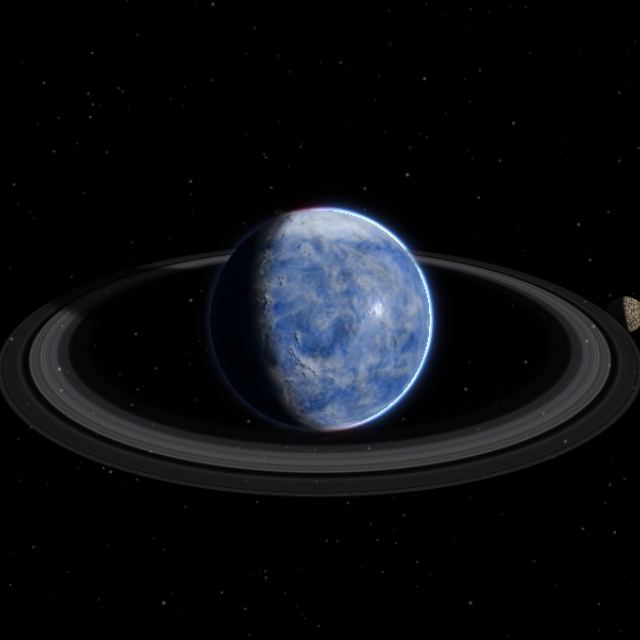
This world was formed from to bigger planets colliding, the collision produced beautiful rings, and 2 moons, one locked in orbit, the other slowly fading away. The planet orbits a G-type star That is 3.8 billion years old. The views are beautiful and amazing on both moons.
Surface. Vast oceans covering most of the surface, scattered islands or archipelagos
✓ Conditions could support life. This planet’s modelled conditions could support biological processes: stable temperatures, liquid water and the chemistry life as we know it needs. That makes life possible, not present.
Water-Rich
Life possibleMagnetic FieldLow Activity
Water worlds have deep global oceans covering most or all of their surface. They form when planets have high water content and orbit in the habitable zone.
Classification Criteria:
✓ Oxygen: 31.0% + Hydrogen: 17.2% (water-forming elements)✓ Temperature: 276K (habitable range)✓ Distance: 1.27 AU (habitable zone)
Habitability ScoreHabitable
Contributing Factors
water78
Abundant water (low gravity lets water escape to space)
geology70
Some geological activity provides slow nutrient cycling (tidal flexing sustains geologic activity)
rotation10
Near tidally locked - one hemisphere perpetually scorched, other frozen, narrow habitable twilight zone only
Organic Chemistry80
Core organic elements (CHNO) present
atmosphere40
Nitrogen and oxygen with water vapor, mild greenhouse effect
Nitrogen-oxygen atmosphere - breathable and protective (partially stripped by slow rotation)temperature100
Optimal temperature range for liquid water and life (large moon stabilizes the axial tilt - steady seasons)
magnetic Field100
Magnetic field provides radiation protection
Physical Properties
Mass
0.50x Earth (2.99e+24 kg)Radius
0.79x Earth (5,057 km)Surface Gravity
0.79x Earth (7.8 m/s²)Surface Temperature
276 K (3 °C / 37 °F)Rotation Period
26.0 hours/day (slower than Earth)Elemental Composition
Closest Real Exoplanet
TRAPPIST-1 e80% similar
Orbiting TRAPPIST-1| Yours | TRAPPIST-1 e | |
|---|---|---|
| Mass | 0.50 × Earth | 0.69 × Earth |
| Radius | 0.97 × Earth | 0.92 × Earth |
| Density (composition) | 3.00 g/cm³ | 4.90 g/cm³ |
| Temperature | 275.7 K | 250.0 K |
| Starlight received | 0.62 × Earth | 0.65 × Earth |
| Star temperature | 5,600 K | 2,566 K |
Moons
Moon 1rings0.35% - 2.8 radii
Inside the Roche limit (2.80 planet radii): torn apart into a ring system.
Moon 2receding0.71% - 8.9 radii
Outside the synchronous orbit: slowly receding, like Luna (~cm per year).
Tidal braking locked the planet to its moon: one face forever moonward.
Moon 3stable0.045% - 95.7 radii
Small and distant: a quiet, stable companion.