Entering orbit…
AI assistant
Habitability
34/ 100
View planet
View star system
View surface
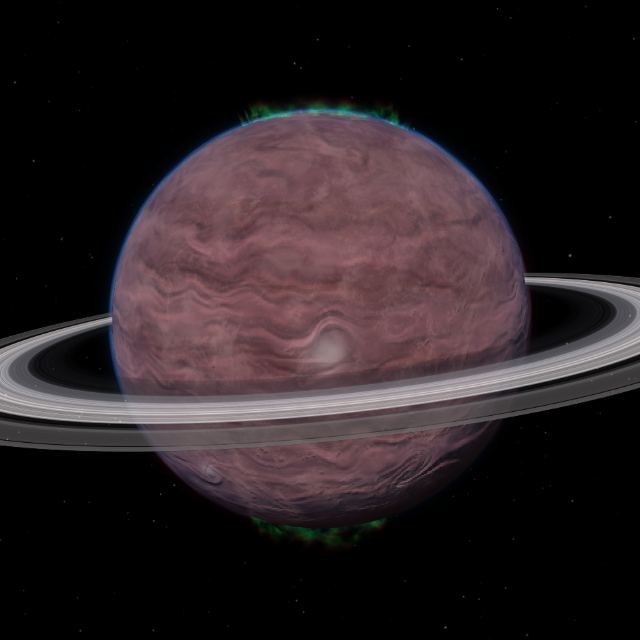
Red Gas Giant
0
Ice Giant
Magnetic FieldExtreme Activity
Why is this a Ice Giant?Your planet has moderate mass (8.3x Earth) with significant water, carbon, and nitrogen content, characteristic of ice giants.
Ice giants like Uranus and Neptune have icy interiors with thick atmospheres of hydrogen and helium, but not enough to be classified as gas giants.
Classification Criteria:
✓ Mass: 8.3x Earth (5-20x range)✓ Water/Carbon/Nitrogen rich composition
Habitability ScoreExtremely Harsh
Contributing Factors
water15
No solid surface — any water is locked in a supercritical mantle and hot ice, not oceans
geology40
Extreme volcanic activity may be hazardous
rotation100
Optimal rotation period - balanced day/night cycle, moderate weather, and good heat distribution
Organic Chemistry80
Core organic elements (CHNO) present
atmosphere30
Hydrogen-rich atmosphere typical of gas giants
temperature70
Challenging but potentially habitable temperature
magnetic Field100
Magnetic field provides radiation protection
Physical Properties
Mass
8.30x Earth (4.96e+25 kg)Radius
2.02x Earth (12,899 km)Surface Gravity
2.02x Earth (19.9 m/s²)Surface Temperature
334 K (60 °C / 141 °F)Rotation Period
24.0 hours/dayOrbital Environment
Star Type
G-type (Yellow (Sun-like))Distance from Star
1.01 AU (151 million km)Orbital Period
1.02 yearsAtmosphere
Hydrogen and helium with water, methane, and ammonia ices
Elemental Composition
H - Hydrogen
53.8%
O - Oxygen
22.3%
C - Carbon
7.9%
Surface Characteristics
No solid surface - a deep volatile envelope over a supercritical water mantle and hot-ice interiorClosest Real Exoplanet
Kepler-1554 b93% similar
Orbiting Kepler-1554| Yours | Kepler-1554 b | |
|---|---|---|
| Mass | 8.30 × Earth | 8.75 × Earth |
| Radius | 3.06 × Earth | 2.90 × Earth |
| Density (composition) | 1.60 g/cm³ | 1.98 g/cm³ |
| Temperature | 333.6 K | 288.0 K |
| Starlight received | 0.98 × Earth | 1.01 × Earth |
| Star temperature | 5,600 K | 5,297 K |
Moons
Moon 1rings10% - 1.9 radii
Inside the Roche limit (1.92 planet radii): torn apart into a ring system.