Entering orbit…
AI assistant
Habitability
73/ 100
View planet
View star system
View surface
Carti
0
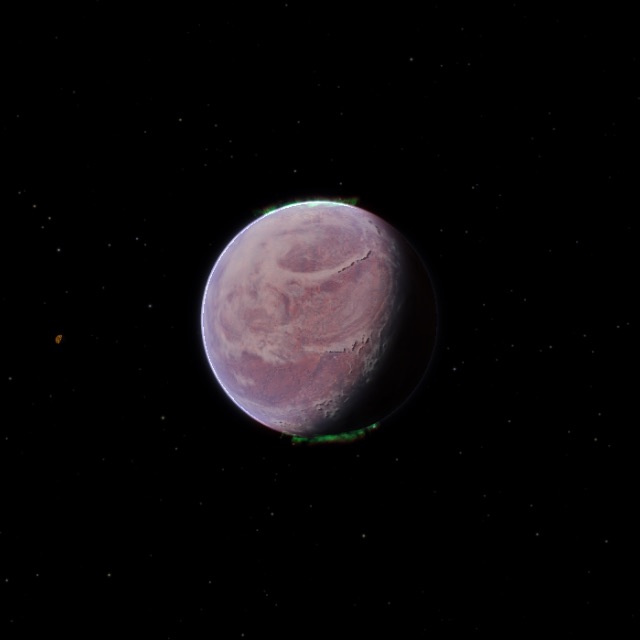
Barren
✦ GoedeoLife possibleMagnetic FieldHigh Activity
Why is this a Barren?Your planet has an unusual composition that doesn't fit standard classifications, or lacks the elements needed for complex geological processes.
Barren worlds can form from uncommon element combinations or may be remnants of larger bodies that lost their atmospheres and volatile materials.
Classification Criteria:
Composition doesn't match standard planet typesMass: 4.7x EarthTemperature: 271K
Habitability ScoreHabitable
Contributing Factors
water49
Limited water content - mostly frozen
geology90
Active geology recycles nutrients and drives carbon cycle
rotation100
Optimal rotation period - balanced day/night cycle, moderate weather, and good heat distribution
Organic Chemistry80
Core organic elements (CHNO) present
atmosphere50
CO₂ atmosphere with moderate greenhouse effect
temperature70
Challenging but potentially habitable temperature
magnetic Field100
Magnetic field provides radiation protection
Physical Properties
Mass
4.70x Earth (2.81e+25 kg)Radius
1.68x Earth (10,672 km)Surface Gravity
1.68x Earth (16.4 m/s²)Surface Temperature
271 K (-2 °C / 29 °F)Rotation Period
20.0 hours/day (faster than Earth)Orbital Environment
Star Type
M-type (Red Dwarf)Distance from Star
0.23 AU (34.4 million km)Orbital Period
74 daysAtmosphere
Thin CO₂ atmosphere
Elemental Composition
O - Oxygen
33.7%
Fe - Iron
15.1%
H - Hydrogen
9.3%
Surface Characteristics
Barren rocky surface with unusual elemental compositionClosest Real Exoplanet
LHS 1140 b85% similar
Orbiting LHS 1140| Yours | LHS 1140 b | |
|---|---|---|
| Mass | 4.70 × Earth | 5.60 × Earth |
| Radius | 1.54 × Earth | 1.73 × Earth |
| Density (composition) | 7.11 g/cm³ | 5.96 g/cm³ |
| Temperature | 271.3 K | 226.0 K |
| Starlight received | 0.76 × Earth | 0.43 × Earth |
| Star temperature | 3,050 K | 3,096 K |
Moons
Moon 1stableSulfur-rich0.00014% - 14.9 radii
Small and distant: a quiet, stable companion.
Moon 2stableIce lost: bare rock0.00022% - 20.7 radii
Small and distant: a quiet, stable companion.
Too warm for ice and too small to hold an atmosphere: the ice sublimated, leaving bare rock.