Entering orbit…
AI assistant
Habitability
0/ 100
View planet
View star system
View surface
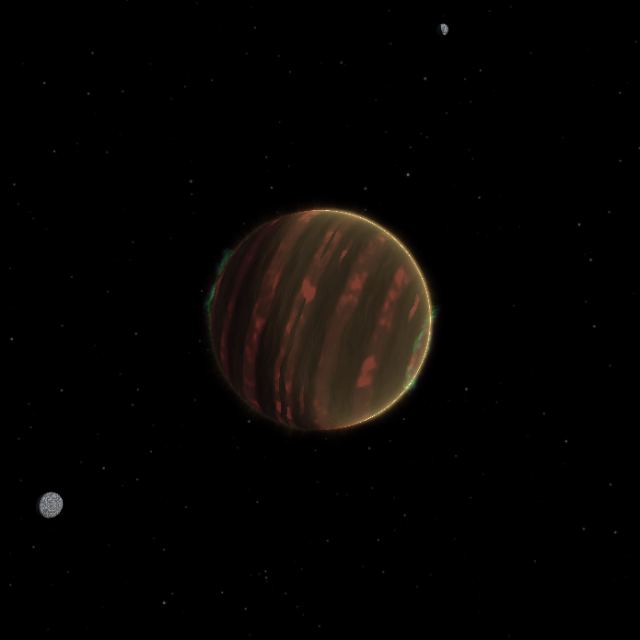
Ergaster
0
Progenitor System
Brown Dwarf
✦ Progenitor SystemMagnetic FieldNone Activity
Why is this a Brown Dwarf?Your planet has an unusual composition that doesn't fit standard classifications, or lacks the elements needed for complex geological processes.
Barren worlds can form from uncommon element combinations or may be remnants of larger bodies that lost their atmospheres and volatile materials.
Classification Criteria:
Composition doesn't match standard planet typesMass: 4186.0x EarthTemperature: 356K
Habitability ScoreUninhabitable
Contributing Factors
water15
No solid surface — any water is locked in a supercritical mantle and hot ice, not oceans
geology30
Geologically dead - no nutrient recycling
rotation100
Optimal rotation period - balanced day/night cycle, moderate weather, and good heat distribution
Organic Chemistry20
Limited organic chemistry potential
atmosphere30
Hydrogen-rich atmosphere typical of gas giants
temperature40
Extreme temperature - very difficult for life (extreme seasons: at 103° the poles swing between months-long day and night: −18% habitability)
magnetic Field20
A strong field, but no surface beneath it — there is nothing here for it to shelter
Physical Properties
Mass
4186.00x Earth (2.50e+28 kg)Radius
16.12x Earth (102,677 km)Surface Gravity
16.12x Earth (158.1 m/s²)Surface Temperature
356 K (83 °C / 181 °F)Rotation Period
24.0 hours/dayOrbital Environment
Star Type
G-type (Yellow (Sun-like))Distance from Star
150.00 AU (22.4 billion km)Orbital Period
1,837 yearsAtmosphere
Cold hydrogen and helium with ammonia and water clouds
Elemental Composition
H - Hydrogen
50.0%
S - Sulfur
50.0%
Surface Characteristics
No surface: the coldest class of failed star, barely warmer than a summer day and glowing only in the infraredClosest Real Exoplanet
COCONUTS-2 b69% similar
Orbiting COCONUTS-2 A| Yours | COCONUTS-2 b | |
|---|---|---|
| Mass | 4,186 × Earth | 2,380 × Earth |
| Radius | 16.1 × Earth | 12.6 × Earth |
| Density (composition) | — | 6.56 g/cm³ |
| Temperature | 355.9 K | 493.0 K |
| Starlight received | 0.00 × Earth | — |
| Star temperature | 5,600 K | 3,552 K |
Moons
Moon 1stable0.0011% - 11.0 radii
Small and distant: a quiet, stable companion.
Moon 2stable0.022% - 70.2 radii
Small and distant: a quiet, stable companion.
Moon 3stable0.0032% - 55.0 radii
Small and distant: a quiet, stable companion.
Moon 4stable0.032% - 24.8 radii
Small and distant: a quiet, stable companion.