Entering orbit…
AI assistant
Habitability
56/ 100
View planet
View star system
View surface
Inert
0
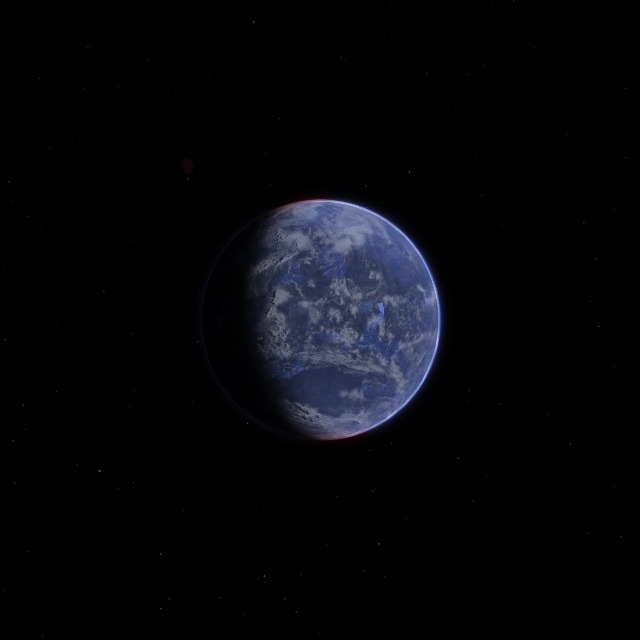
Inert was once a frozen world but Now it’s warmed up and has water life is still underneath its surface but it has three moons Elopelp a Brown moon almost the same size as the earths moon and Olson is a completely black moon and the second biggest Estop is the smallest And is icy
Life possibleMagnetic FieldLow Activity
Why is this a Barren?Your planet has an unusual composition that doesn't fit standard classifications, or lacks the elements needed for complex geological processes.
Barren worlds can form from uncommon element combinations or may be remnants of larger bodies that lost their atmospheres and volatile materials.
Classification Criteria:
Composition doesn't match standard planet typesMass: 0.7x EarthTemperature: 263K
Habitability ScoreMarginal
Contributing Factors
water92
Abundant water - mostly frozen (low gravity lets water escape to space)
geology60
Some geological activity provides slow nutrient cycling
rotation10
Near tidally locked - one hemisphere perpetually scorched, other frozen, narrow habitable twilight zone only
Organic Chemistry84
Core organic elements (CHNO) present (tidal pools cycle wet and dry - a boost for prebiotic chemistry)
atmosphere28
Nitrogen atmosphere provides protection but not breathable (partially stripped by slow rotation)
temperature70
Challenging but potentially habitable temperature
magnetic Field100
Magnetic field provides radiation protection
Physical Properties
Mass
0.70x Earth (4.18e+24 kg)Radius
0.89x Earth (5,657 km)Surface Gravity
0.89x Earth (8.7 m/s²)Surface Temperature
263 K (-10 °C / 14 °F)Rotation Period
24.0 hours/dayOrbital Environment
Star Type
A-type (Blue-White)Distance from Star
18.90 AU (2.83 billion km)Orbital Period
58.1 yearsAtmosphere
Thin CO₂ and nitrogen atmosphere
Elemental Composition
H - Hydrogen
42.9%
C - Carbon
19.2%
O - Oxygen
17.9%
Surface Characteristics
Barren rocky surface with unusual elemental compositionClosest Real Exoplanet
Teegarden's Star d76% similar
Orbiting Teegarden's Star| Yours | Teegarden's Star d | |
|---|---|---|
| Mass | 0.70 × Earth | 0.82 × Earth |
| Radius | 0.92 × Earth | 0.95 × Earth |
| Density (composition) | 4.95 g/cm³ | 5.20 g/cm³ |
| Temperature | 263.3 K | 159.0 K |
| Starlight received | 0.11 × Earth | 0.12 × Earth |
| Star temperature | 8,750 K | 3,034 K |
Moons
Moon 1recedingVolcanic0.079% - 11.7 radii
Outside the synchronous orbit: slowly receding, like Luna (~cm per year).
Tidal braking locked the planet to its moon: one face forever moonward.
Tidal flexing melts its interior: an actively volcanic surface (Io-like).
Moon 2stableIron-rich rock0.013% - 17.8 radii
Small and distant: a quiet, stable companion.
Moon 3stableNitrogen ices lost: water ice0.00040% - 23.2 radii
Small and distant: a quiet, stable companion.
Too warm for nitrogen and methane frost and too small to hold them as an atmosphere: those ices escaped to space, leaving water ice.