Entering orbit…
AI assistant
Habitability
0/ 100
View planet
View star system
View surface
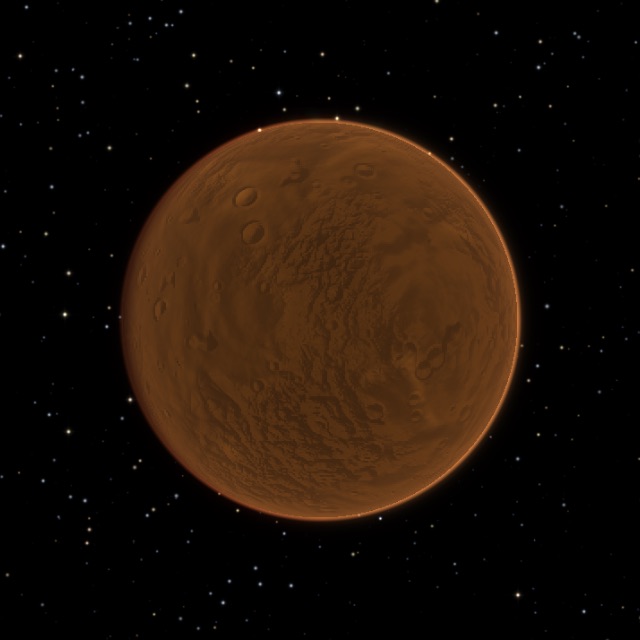
Sidero
- Mass
- 0.50 × Earth
- Radius
- 0.79 × Earth
- Gravity
- 0.79 g
- Surface
- 244 K
- Year
- 88.4 days
- Day
- 31.0 hrs
- Mass
- 0.50 × Earth
- Radius
- 0.79 × Earth
- Gravity
- 0.79 g
- Surface
- 244 K
- Year
- 88.4 days
- Day
- 31.0 hrs
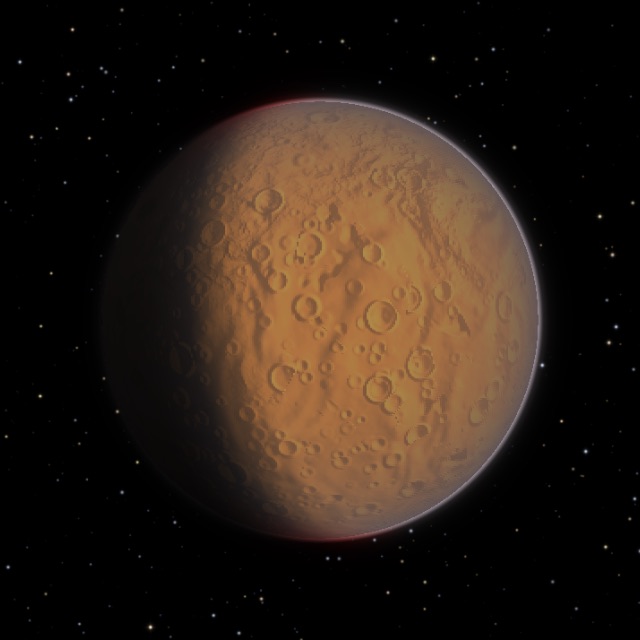
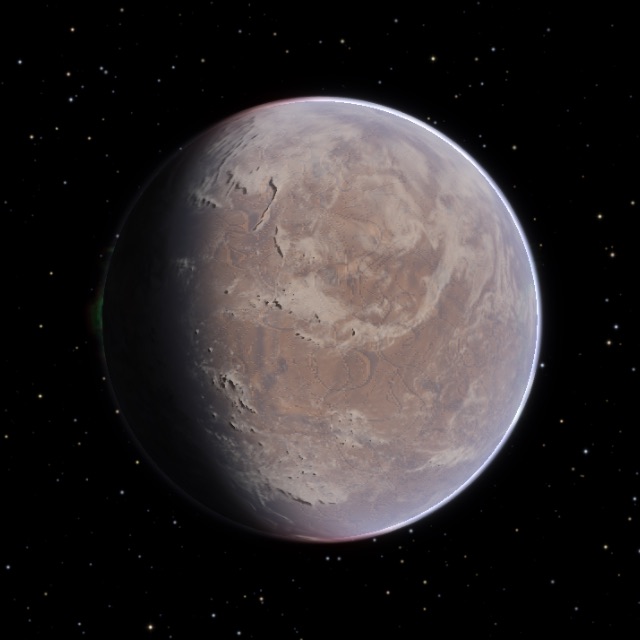
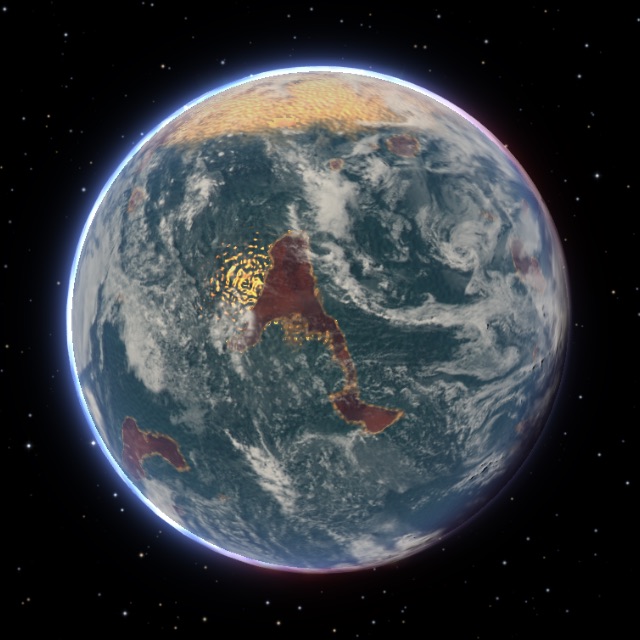 Sidero0.26 AURocky TerrestrialYou are here
Habitable zone
Star and planets drawn to scale (a typical star of its class), with only the star's edge in view. Orbits spaced as in the star system view.
Sidero's moons
1 moon
Moon 1Sulfur · 51,800 km
Planet, moons and orbits drawn to one scale; the smallest moons are enlarged so they can be seen.
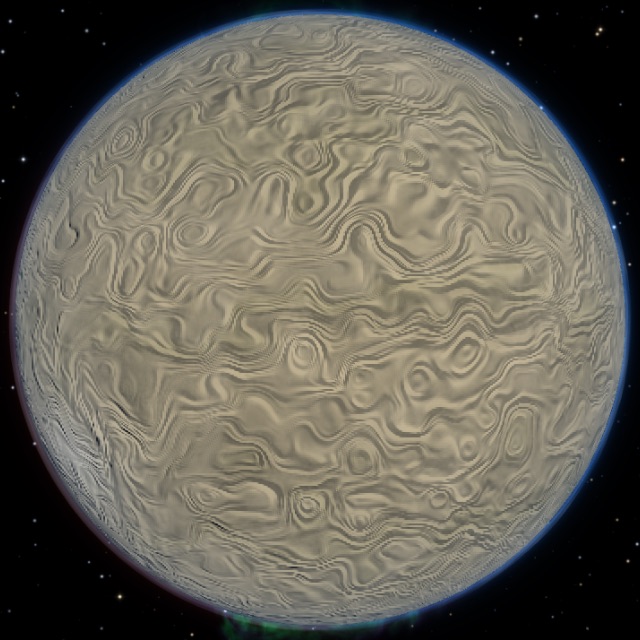
A Mars-like planet, on the brink of the exit of the habitable zone, research on the planet has confirmed it used to have small organisms and vast seas, meaning it had life, but as its orbit got farther, lost it to the cold.
Surface. Rocky surface with impact craters, possible volcanic features
Rocky Terrestrial
✦ Julius-A
Your planet is dominated by silicate (14.3%) and iron (47.6%) content, forming a rocky terrestrial body.Magnetic FieldLow Activity
Rocky terrestrial planets are primarily composed of silicate rocks and metals. They're the most common type of small planet in the universe.
Classification Criteria:
✓ Silicon: 14.3% + Iron: 47.6% + Magnesium: 0.0%✓ Mass: 0.5x Earth (terrestrial range)
Habitability ScoreUninhabitable
Contributing Factors
water0
No water - the recipe has no hydrogen and oxygen to form it
geology60
Some geological activity provides slow nutrient cycling
rotation100
Optimal rotation period - balanced day/night cycle, moderate weather, and good heat distribution
Organic Chemistry20
Limited organic chemistry potential
atmosphere70
Thin, dusty CO₂ and nitrogen atmosphere
Nitrogen atmosphere provides protection but not breathabletemperature40
Extreme temperature - very difficult for life
magnetic Field100
Magnetic field provides radiation protection
Physical Properties
Mass
0.50x Earth (2.99e+24 kg)Radius
0.79x Earth (5,057 km)Surface Gravity
0.79x Earth (7.8 m/s²)Surface Temperature
244 K (-29 °C / -21 °F)Rotation Period
31.0 hours/day (slower than Earth)Elemental Composition
Closest Real Exoplanet
TRAPPIST-1 e90% similar
Orbiting TRAPPIST-1| Yours | TRAPPIST-1 e | |
|---|---|---|
| Mass | 0.50 × Earth | 0.69 × Earth |
| Radius | 0.84 × Earth | 0.92 × Earth |
| Density (composition) | 4.65 g/cm³ | 4.90 g/cm³ |
| Temperature | 243.8 K | 250.0 K |
| Starlight received | 0.59 × Earth | 0.65 × Earth |
| Star temperature | 3,050 K | 2,566 K |
Moons
Moon 1stableSulfur-rich
Small and distant: a quiet, stable companion.