Entering orbit…
AI assistant
Habitability
12/ 100
View planet
View star system
View surface
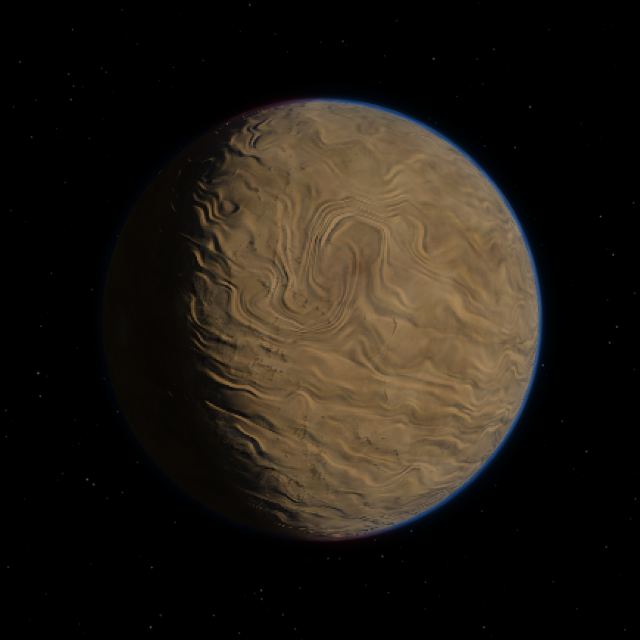
kimov
0
Gas Giant
✦ nalruter system (AV 15)Life unlikely — too cold for liquid waterMagnetic FieldExtreme Activity
Why is this a Gas Giant?
Your planet has 10.0% hydrogen and helium, combined with a mass of 9.3x Earth, which exceeds the gas giant threshold.Gas giants form when massive cores capture enormous atmospheres of light gases. They typically form beyond the 'frost line' where volatiles can condense.
Classification Criteria:
✓ Hydrogen + Helium: 10.0% (>60% required)✓ Mass: 9.3x Earth (>10x required)
Habitability ScoreUninhabitable
Contributing Factors
water15
No solid surface — any water is locked in a supercritical mantle and hot ice, not oceans
geology40
Extreme volcanic activity may be hazardous
rotation100
Optimal rotation period - balanced day/night cycle, moderate weather, and good heat distribution
Organic Chemistry75
All CHNOPS elements present - building blocks of life - chlorine-laced environment attacks organic molecules — but the ground itself is radioactive, and no magnetic field shields a world from its own crust
atmosphere30
Hydrogen-rich atmosphere typical of gas giants
temperature10
Frozen world - minimal potential for complex life
magnetic Field100
Magnetic field provides radiation protection
Physical Properties
Mass
9.30x Earth (5.55e+25 kg)Radius
2.10x Earth (13,398 km)Surface Gravity
2.10x Earth (20.6 m/s²)Surface Temperature
91 K (-183 °C / -297 °F)Rotation Period
24.0 hours/dayOrbital Environment
Star Type
G-type (Yellow (Sun-like))Distance from Star
9.42 AU (1.41 billion km)Orbital Period
28.9 yearsAtmosphere
Hydrogen and helium dominated with trace methane and ammonia
Elemental Composition
C - Carbon
5.0%
H - Hydrogen
5.0%
K - Potassium
5.0%
Surface Characteristics
No solid surface - thick gaseous envelope with possible rocky core deep withinClosest Real Exoplanet
GJ 1151 c87% similar
Orbiting GJ 1151| Yours | GJ 1151 c | |
|---|---|---|
| Mass | 9.30 × Earth | 10.6 × Earth |
| Radius | 3.40 × Earth | 3.25 × Earth |
| Density (composition) | 1.30 g/cm³ | 1.70 g/cm³ |
| Temperature | 90.6 K | 88.0 K |
| Starlight received | 0.01 × Earth | 0.01 × Earth |
| Star temperature | 5,600 K | 3,280 K |
Love TerraForge? Please help support us.Keeps it ad-free, and funds new features and hosting.