Entering orbit…
AI assistant
Habitability
0/ 100
View planet
View star system
View surface
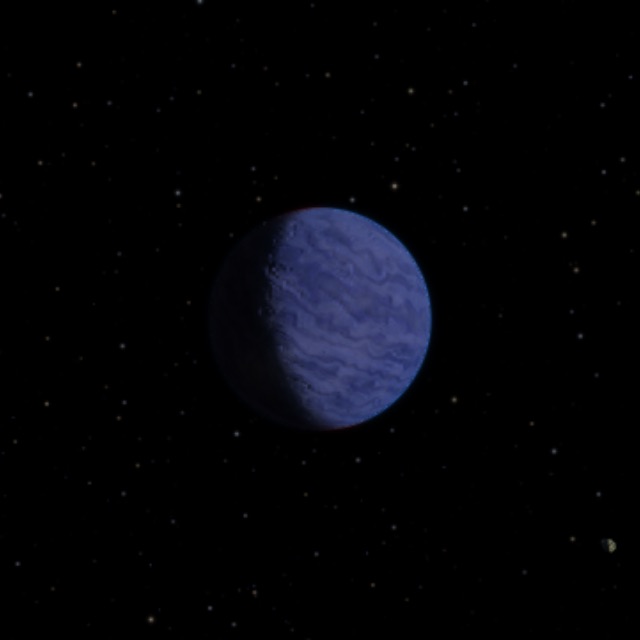
Ravenhoff
0
Ice Giant
✦ Abale and TerefMagnetic FieldModerate Activity
Why is this a Ice Giant?Your planet has moderate mass (17.0x Earth) with significant water, carbon, and nitrogen content, characteristic of ice giants.
Ice giants like Uranus and Neptune have icy interiors with thick atmospheres of hydrogen and helium, but not enough to be classified as gas giants.
Classification Criteria:
✓ Mass: 17.0x Earth (5-20x range)✓ Water/Carbon/Nitrogen rich composition
Habitability ScoreUninhabitable
Contributing Factors
water15
No solid surface — any water is locked in a supercritical mantle and hot ice, not oceans
geology90
Active geology recycles nutrients and drives carbon cycle
rotation10
Near tidally locked - one hemisphere perpetually scorched, other frozen, narrow habitable twilight zone only
Organic Chemistry84
Core organic elements (CHNO) present (tidal pools cycle wet and dry - a boost for prebiotic chemistry)
atmosphere12
Hydrogen-rich atmosphere typical of gas giants (partially stripped by slow rotation)
temperature0
Near absolute zero - all molecular activity ceases, impossible for life
magnetic Field100
Magnetic field provides radiation protection
Physical Properties
Mass
17.00x Earth (1.02e+26 kg)Radius
2.57x Earth (16,382 km)Surface Gravity
2.57x Earth (25.2 m/s²)Surface Temperature
34 K (-239 °C / -398 °F)Rotation Period
16.0 hours/day (faster than Earth)Orbital Environment
Star Type
BH-type (Black Hole)Distance from Star
3000.00 AU (449 billion km)Orbital Period
51,962 yearsAtmosphere
Hydrogen and helium with water, methane, and ammonia ices
Elemental Composition
H - Hydrogen
40.0%
He - Helium
25.0%
C - Carbon
15.0%
Surface Characteristics
Icy mantle surrounding rocky core, with hydrogen-helium atmosphereClosest Real Exoplanet
KMT-2021-BLG-0171L b68% similar
Orbiting KMT-2021-BLG-0171L| Yours | KMT-2021-BLG-0171L b | |
|---|---|---|
| Mass | 17.0 × Earth | 11.2 × Earth |
| Radius | 3.88 × Earth | 3.35 × Earth |
| Density (composition) | 1.60 g/cm³ | 1.64 g/cm³ |
| Temperature | 34.2 K | — |
| Starlight received | 0.00 × Earth | — |
| Star temperature | — | 5,200 K |
Moons
Moon 1stableWater ice0.010% - 75.0 radii
Small and distant: a quiet, stable companion.
Tidal braking locked the planet to its moon: one face forever moonward.
Moon 2stableIron-rich rock0.010% - 13.4 radii
Small and distant: a quiet, stable companion.
Moon 3merged0.010% - 22.7 radii
Merged with an adjacent moon: too close for both to hold a stable orbit.
Moon 4stableNitrogen & methane ice0.010% - 20.3 radii
Small and distant: a quiet, stable companion.
Cold enough for nitrogen and methane to lie as frost on the surface (Triton-like).
Moon 5merged0.010% - 21.7 radii
Merged with an adjacent moon: too close for both to hold a stable orbit.
Moon 6stableOcean world0.010% - 6.3 radii
Small and distant: a quiet, stable companion.
A thin tidal-warmed subsurface ocean may exist, but conditions are marginal (12/100).