Entering orbit…
AI assistant
Habitability
98/ 100
View planet
View star system
View surface
gafarna
0
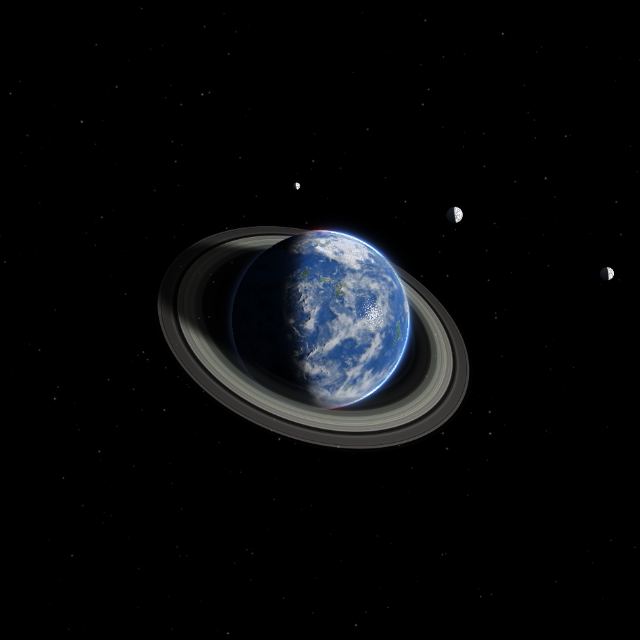
is a another 98 habitability world and also is more perfect than zafarna home of gafarnians and is most advanced out of four because is oldest and also it had four moons and also it had rings due to roche limit of a former major moons and also is a furthest one of my system
Earth Like
✦ cafarnaLife possibleMagnetic FieldModerate Activity
Why is this a Earth Like?
Your planet has a balanced composition with all CHNOPS elements, proper mass (0.8x Earth), and sits in the habitable zone at 1.12 AU.Earth-like planets have the perfect combination of composition, temperature, mass, and magnetic field to potentially support complex life as we know it.
Classification Criteria:
✓ All CHNOPS elements present (C, H, N, O, P, S)✓ Mass: 0.8x Earth (0.5-2.0x range)✓ Temperature: 294K (250-320K range)✓ Magnetic field present✓ Distance: 1.12 AU (habitable zone)
Habitability ScoreHighly Habitable
Contributing Factors
water100
Abundant water
geology90
Active geology recycles nutrients and drives carbon cycle
rotation100
Optimal rotation period - balanced day/night cycle, moderate weather, and good heat distribution
Organic Chemistry100
All CHNOPS elements present - building blocks of life (tidal pools cycle wet and dry - a boost for prebiotic chemistry)
atmosphere100
Nitrogen-oxygen atmosphere - breathable and protective
temperature100
Optimal temperature range for liquid water and life
magnetic Field100
Magnetic field provides radiation protection
Physical Properties
Mass
0.80x Earth (4.78e+24 kg)Radius
0.93x Earth (5,914 km)Surface Gravity
0.93x Earth (9.1 m/s²)Surface Temperature
294 K (21 °C / 69 °F)Rotation Period
16.0 hours/day (faster than Earth)Orbital Environment
Star Type
G-type (Yellow (Sun-like))Distance from Star
1.12 AU (168 million km)Orbital Period
1.19 yearsAtmosphere
Nitrogen-oxygen atmosphere with trace CO₂, water vapor, and argon
Elemental Composition
O - Oxygen
25.0%
H - Hydrogen
17.6%
Si - Silicon
15.5%
Surface Characteristics
Rocky surface with continents, oceans, and active plate tectonics. Diverse biomes if life present.Closest Real Exoplanet
TOI-700 e86% similar
Orbiting TOI-700| Yours | TOI-700 e | |
|---|---|---|
| Mass | 0.80 × Earth | 0.72 × Earth |
| Radius | 0.94 × Earth | 0.92 × Earth |
| Density (composition) | 5.27 g/cm³ | 5.10 g/cm³ |
| Temperature | 293.7 K | 273.0 K |
| Starlight received | 0.80 × Earth | 1.27 × Earth |
| Star temperature | 5,600 K | 3,459 K |
Moons
Moon 1stable0.00011% - 16.0 radii
Small and distant: a quiet, stable companion.
Moon 2receding0.056% - 25.4 radii
Outside the synchronous orbit: slowly receding, like Luna (~cm per year).
Moon 3receding0.25% - 58.8 radii
Outside the synchronous orbit: slowly receding, like Luna (~cm per year).
Moon 4receding0.10% - 95.7 radii
Outside the synchronous orbit: slowly receding, like Luna (~cm per year).
Moon 5rings0.63% - 1.9 radii
Inside the Roche limit (2.80 planet radii): torn apart into a ring system.
Habitability
✓ Conditions could support lifeThis planet’s modelled conditions could support biological processes: stable temperatures, liquid water and the chemistry life as we know it needs. That makes life possible, not present.Love TerraForge? Please help support us.Keeps it ad-free, and funds new features and hosting.