Entering orbit…
AI assistant
Habitability
82/ 100
View planet
View star system
View surface
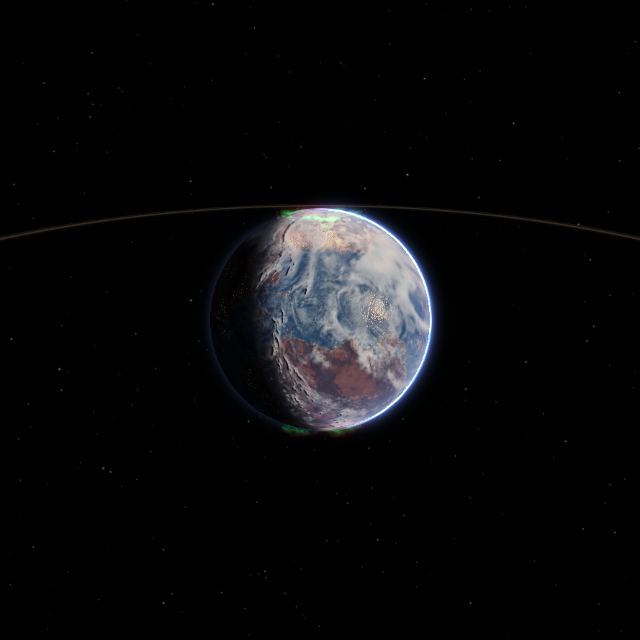
mono-7.890
- Mass
- 4.10 × Earth
- Radius
- 1.60 × Earth
- Gravity
- 1.60 g
- Surface
- 270 K
- Year
- 250 days
- Day
- 24.0 hrs
- Mass
- 4.10 × Earth
- Radius
- 1.60 × Earth
- Gravity
- 1.60 g
- Surface
- 270 K
- Year
- 250 days
- Day
- 24.0 hrs
mono-7.890's star
K-type · Orange
mono-7.8900.69 AUEarth LikeYou are hereHabitable zone
Star and planet drawn to scale (a typical star of its class), with only the star's edge in view. Orbits spaced as in the star system view.
its earths very best friend and has life like no planet ever did or has today. Not only plants, bee-dinosur like life wasp like life and the most common spiesheis of life on this planet is the kiki.
Surface. Rocky surface with continents, oceans, and active plate tectonics. Diverse biomes if life present.
✓ Conditions could support life. This planet’s modelled conditions could support biological processes: stable temperatures, liquid water and the chemistry life as we know it needs. That makes life possible, not present.
Earth Like
Life possibleMagnetic FieldModerate Activity
Earth-like planets have the perfect combination of composition, temperature, mass, and magnetic field to potentially support complex life as we know it.
Classification Criteria:
✓ All CHNOPS elements present (C, H, N, O, P, S)✓ Mass: 4.1x Earth (0.5-2.0x range)✓ Temperature: 270K (250-320K range)✓ Magnetic field present✓ Distance: 0.69 AU (habitable zone)
Habitability ScoreHighly Habitable
Contributing Factors
water49
Limited water content - mostly frozen
geology90
Active geology recycles nutrients and drives carbon cycle
rotation100
Optimal rotation period - balanced day/night cycle, moderate weather, and good heat distribution
Organic Chemistry80
Core organic elements (CHNO) present
atmosphere100
Nitrogen-oxygen atmosphere with trace CO₂, water vapor, and argon
Nitrogen-oxygen atmosphere - breathable and protectivetemperature70
Challenging but potentially habitable temperature
magnetic Field100
Magnetic field provides radiation protection
Physical Properties
Mass
4.10x Earth (2.45e+25 kg)Radius
1.60x Earth (10,197 km)Surface Gravity
1.60x Earth (15.7 m/s²)Surface Temperature
270 K (-3 °C / 26 °F)Rotation Period
24.0 hours/dayElemental Composition
Closest Real Exoplanet
Kepler-1652 b85% similar
Orbiting Kepler-1652| Yours | Kepler-1652 b | |
|---|---|---|
| Mass | 4.10 × Earth | 3.19 × Earth |
| Radius | 1.46 × Earth | 1.60 × Earth |
| Density (composition) | 7.19 g/cm³ | 4.29 g/cm³ |
| Temperature | 270.0 K | 268.0 K |
| Starlight received | 0.84 × Earth | 0.81 × Earth |
| Star temperature | 4,450 K | 3,638 K |
Moons
Moon 1rings
Inside the Roche limit (2.80 planet radii): torn apart into a ring system.
Moon 2rings
Inside the synchronous orbit: it spiraled inward and was torn apart at the Roche limit (Phobos's fate).
Moon 3rings
Inside the synchronous orbit: it spiraled inward and was torn apart at the Roche limit (Phobos's fate).
Moon 4merged
Merged with an adjacent moon: too close for both to hold a stable orbit.
Moon 5merged
Merged with an adjacent moon: too close for both to hold a stable orbit.