Entering orbit…
AI assistant
Habitability
60/ 100
View planet
View star system
View surface
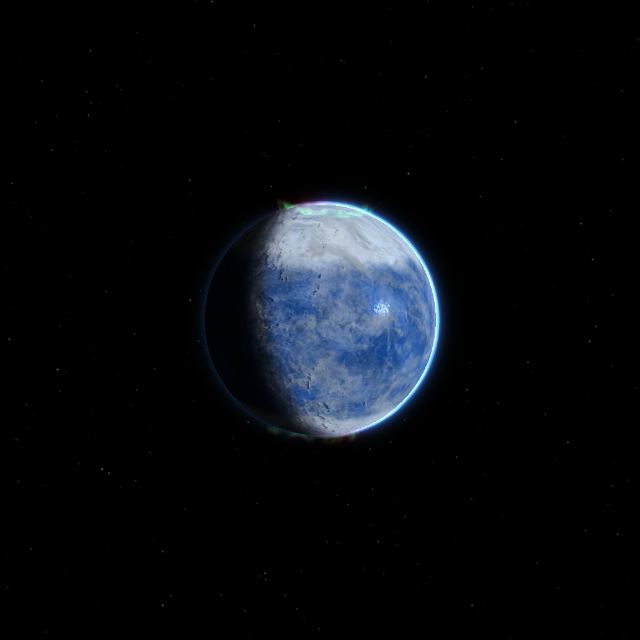
Ghiaxyo
0
Water World
✦ NecàìoLife possibleMagnetic FieldModerate Activity
Why is this a Water World?Your planet has abundant oxygen (27.8%) and hydrogen (12.2%), creating extensive water coverage while in the habitable temperature zone.
Water worlds have deep global oceans covering most or all of their surface. They form when planets have high water content and orbit in the habitable zone.
Classification Criteria:
✓ Oxygen: 27.8% + Hydrogen: 12.2% (water-forming elements)✓ Temperature: 254K (habitable range)✓ Distance: 0.33 AU (habitable zone)
Habitability ScoreHabitable
Contributing Factors
water76
Good water content - mostly frozen
geology90
Active geology recycles nutrients and drives carbon cycle
rotation10
Near tidally locked - one hemisphere perpetually scorched, other frozen, narrow habitable twilight zone only
Organic Chemistry100
All CHNOPS elements present - building blocks of life (tidal pools cycle wet and dry - a boost for prebiotic chemistry)
atmosphere40
Nitrogen-oxygen atmosphere - breathable and protective (partially stripped by slow rotation)
temperature70
Challenging but potentially habitable temperature
magnetic Field100
Magnetic field provides radiation protection
Physical Properties
Mass
1.00x Earth (5.97e+24 kg)Radius
1.00x Earth (6,371 km)Surface Gravity
1.00x Earth (9.8 m/s²)Surface Temperature
254 K (-19 °C / -3 °F)Rotation Period
25.0 hours/day (slower than Earth)Orbital Environment
Star Type
NS-type (Neutron Star)Distance from Star
0.33 AU (49.4 million km)Orbital Period
59 daysAtmosphere
Nitrogen and oxygen with water vapor, mild greenhouse effect
Elemental Composition
O - Oxygen
27.8%
C - Carbon
18.8%
H - Hydrogen
12.2%
Surface Characteristics
Vast oceans covering most of the surface, scattered islands or archipelagosClosest Real Exoplanet
Teegarden's Star d79% similar
Orbiting Teegarden's Star| Yours | Teegarden's Star d | |
|---|---|---|
| Mass | 1.00 × Earth | 0.82 × Earth |
| Radius | 1.22 × Earth | 0.95 × Earth |
| Density (composition) | 3.00 g/cm³ | 5.20 g/cm³ |
| Temperature | 253.8 K | 159.0 K |
| Starlight received | 0.09 × Earth | 0.12 × Earth |
| Star temperature | — | 3,034 K |
Moons
Moon 1stableVolcanic0.010% - 8.8 radii
Small and distant: a quiet, stable companion.
Tidal braking locked the planet to its moon: one face forever moonward.
Tidal flexing melts its interior: an actively volcanic surface (Io-like).
Moon 2merged0.010% - 9.1 radii
Merged with an adjacent moon: too close for both to hold a stable orbit.
Moon 3merged0.0032% - 9.3 radii
Merged with an adjacent moon: too close for both to hold a stable orbit.
Moon 4stableCarbon-rich0.010% - 23.5 radii
Small and distant: a quiet, stable companion.
Moon 5stableSulfur-rich0.00022% - 7.4 radii
Small and distant: a quiet, stable companion.
Moon 6stableNitrogen ices lost: water ice0.010% - 11.2 radii
Small and distant: a quiet, stable companion.
Too warm for nitrogen and methane frost and too small to hold them as an atmosphere: those ices escaped to space, leaving water ice.