Entering orbit…
AI assistant
Habitability
0/ 100
View planet
View star system
View surface
Ruth021
0
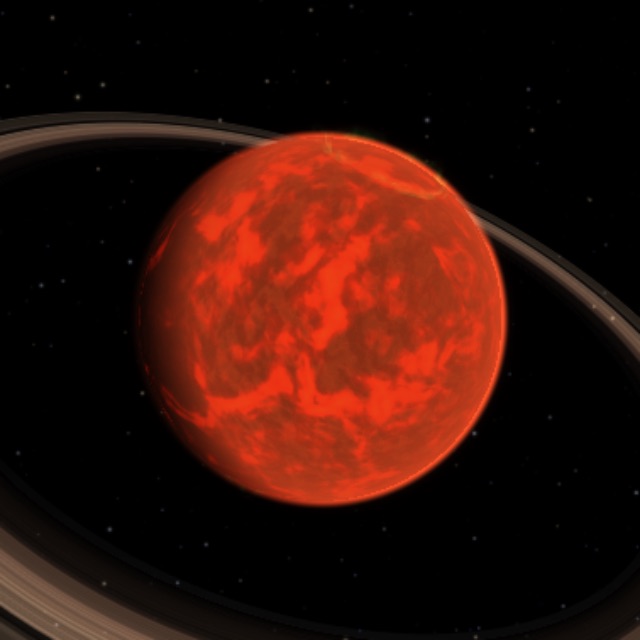
Lava World
✦ Vesper-9No life — too hot for liquid waterMagnetic FieldExtreme Activity
Why is this a Lava World?Your planet's proximity to its star (0.88 AU) results in extreme surface temperatures of 1335K.
Lava worlds orbit so close to their stars that rocky surfaces melt into oceans of molten rock. Recent planet formation can also create temporary lava worlds.
Classification Criteria:
✓ Temperature: 1335K (>1000K)
Habitability ScoreUninhabitable
Contributing Factors
water8
Limited water content - boiling away, little would be retained
geology40
Extreme volcanic activity may be hazardous
rotation10
Near tidally locked - one hemisphere perpetually scorched, other frozen, narrow habitable twilight zone only
Organic Chemistry84
Core organic elements (CHNO) present (tidal pools cycle wet and dry - a boost for prebiotic chemistry)
atmosphere16
Atmosphere present but composition not ideal for life (partially stripped by slow rotation)
temperature0
Inferno world - temperatures exceed all possibility of life
magnetic Field100
Magnetic field provides radiation protection
Physical Properties
Mass
1.00x Earth (5.97e+24 kg)Radius
1.00x Earth (6,371 km)Surface Gravity
1.00x Earth (9.8 m/s²)Surface Temperature
1,335 K (1,062 °C / 1,944 °F)Rotation Period
24.0 hours/dayOrbital Environment
Star Type
BH-type (Black Hole)Distance from Star
0.88 AU (132 million km)Orbital Period
95 daysTime Dilation
Clocks run 5.3 seconds per year slower than deep space — about 7 minutes over a lifetimeAtmosphere
Vaporized rock and metals
Elemental Composition
O - Oxygen
31.3%
Si - Silicon
25.0%
N - Nitrogen
12.5%
Surface Characteristics
Molten surface with lava flows, volcanic activity everywhereClosest Real Exoplanet
Kepler-969 c97% similar
Orbiting Kepler-969| Yours | Kepler-969 c | |
|---|---|---|
| Mass | 1.00 × Earth | 0.94 × Earth |
| Radius | 1.00 × Earth | 0.99 × Earth |
| Density (composition) | 5.50 g/cm³ | 5.32 g/cm³ |
| Temperature | 1,335 K | 1,270 K |
| Starlight received | 516.5 × Earth | 565.0 × Earth |
| Star temperature | — | 5,214 K |
Moons
Moon 1stable0.040% - 7.5 radii
Small and distant: a quiet, stable companion.
Tidal braking locked the planet to its moon: one face forever moonward.
Moon 2merged0.71% - 3.0 radii
Merged with an adjacent moon: too close for both to hold a stable orbit.
Moon 3rings0.13% - 2.7 radii
Inside the Roche limit (2.80 planet radii): torn apart into a ring system.