Entering orbit…
AI assistant
Habitabilityno longer habitable
View planet
View star system
View surface
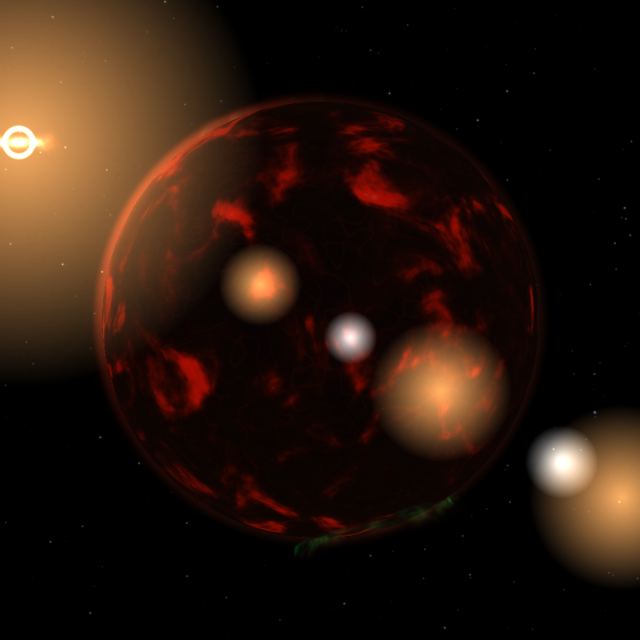
lava earth
0
Lava World
✦ I Don't KnowDestroyed — no longer habitableMagnetic FieldExtreme Activity
Why is this a Lava World?Your planet's proximity to its star (1.00 AU) results in extreme surface temperatures of 1244K.
Lava worlds orbit so close to their stars that rocky surfaces melt into oceans of molten rock. Recent planet formation can also create temporary lava worlds.
Classification Criteria:
✓ Temperature: 1244K (>1000K)
Habitability
Destroyed — no longer habitablePhysical Properties
Mass
1.00x Earth (5.97e+24 kg)Radius
1.00x Earth (6,371 km)Surface Gravity
1.00x Earth (9.8 m/s²)Surface Temperature
1,244 K (971 °C / 1,780 °F)Rotation Period
24.0 hours/dayOrbital Environment
Star Type
BH-type (Black Hole)Distance from Star
1.00 AU (150 million km)Orbital Period
116 daysAtmosphere
Vaporized rock and metals
Elemental Composition
Si - Silicon
40.5%
O - Oxygen
22.9%
H - Hydrogen
10.7%
Surface Characteristics
Molten surface with lava flows, volcanic activity everywhereClosest Real Exoplanet
Kepler-197 b97% similar
Orbiting Kepler-197| Yours | Kepler-197 b | |
|---|---|---|
| Mass | 1.00 × Earth | 1.04 × Earth |
| Radius | 1.00 × Earth | 1.02 × Earth |
| Density (composition) | 5.50 g/cm³ | 5.40 g/cm³ |
| Temperature | 1,244 K | 1,142 K |
| Starlight received | 400.0 × Earth | 431.0 × Earth |
| Star temperature | — | 6,004 K |