Entering orbit…
AI assistant
Habitability
0/ 100
View planet
View star system
View surface
lavta
0
un discovered
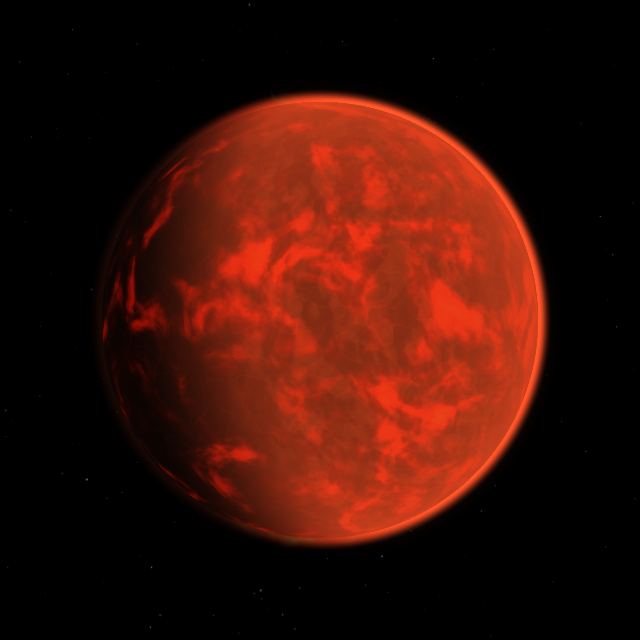
Lava World
✦ solmaLife unlikely — too hot for liquid waterMagnetic FieldExtreme Activity
Why is this a Lava World?
Your planet's proximity to its star (0.13 AU) results in extreme surface temperatures of 1133K.Lava worlds orbit so close to their stars that rocky surfaces melt into oceans of molten rock. Recent planet formation can also create temporary lava worlds.
Classification Criteria:
✓ Temperature: 1133K (>1000K)
Habitability ScoreUninhabitable
Contributing Factors
water8
Limited water content - boiling away, little would be retained
geology40
Extreme volcanic activity may be hazardous
rotation65
Slow rotation - significant day/night temperature variations, but life can adapt
Organic Chemistry100
All CHNOPS elements present - building blocks of life
atmosphere40
Atmosphere present but composition not ideal for life
temperature0
Inferno world - temperatures exceed all possibility of life
magnetic Field100
Magnetic field provides radiation protection
Physical Properties
Mass
1.50x Earth (8.96e+24 kg)Radius
1.14x Earth (7,293 km)Surface Gravity
1.14x Earth (11.2 m/s²)Surface Temperature
1,133 K (860 °C / 1,579 °F)Rotation Period
83.0 hours/day (slower than Earth)Orbital Environment
Star Type
K-type (Orange)Distance from Star
0.13 AU (19.4 million km)Orbital Period
20 daysAtmosphere
Vaporized rock and metals
Elemental Composition
C - Carbon
33.0%
O - Oxygen
22.7%
Fe - Iron
12.4%
Surface Characteristics
Molten surface with lava flows, volcanic activity everywhereClosest Real Exoplanet
tau Cet g83% similar
Orbiting tau Cet| Yours | tau Cet g | |
|---|---|---|
| Mass | 1.50 × Earth | 1.75 × Earth |
| Radius | 1.12 × Earth | 1.18 × Earth |
| Density (composition) | 5.94 g/cm³ | 5.87 g/cm³ |
| Temperature | 1,133 K | 640.0 K |
| Starlight received | 23.7 × Earth | 28.0 × Earth |
| Star temperature | 4,450 K | 5,310 K |
Love TerraForge? Please help support us.Keeps it ad-free, and funds new features and hosting.