Entering orbit…
AI assistant
Habitability
0/ 100
View planet
View star system
View surface
death sentence
0
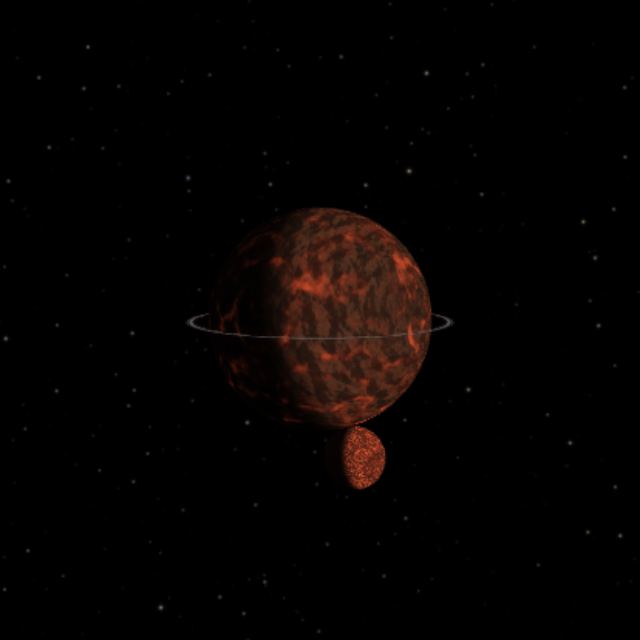
Volcanic World
✦ ZoliascMagnetic FieldExtreme Activity
Why is this a Volcanic World?Runaway tidal heating from its moons drives volcanism across a cold crust - the planet is kneaded like Io.
Resonant, close-in moons pump orbital eccentricity, and the resulting tidal flexing dissipates enormous heat in the interior. Only a fraction of the surface is molten at once, so the ground between the vents stays as cold as the orbit allows - Io's own equilibrium temperature is about 110 K.
Classification Criteria:
✓ Close-in moons in a resonant configuration✓ Tidal heat flux beyond the runaway threshold- The orbit is not what melted it: 0.10 AU, 1597K equilibrium
Habitability ScoreUninhabitable
Contributing Factors
water15
Abundant water - boiling away, little would be retained
geology40
Extreme volcanic activity may be hazardous
rotation10
Near tidally locked - one hemisphere perpetually scorched, other frozen, narrow habitable twilight zone only
Organic Chemistry55
Core organic elements (CHNO) present - chlorine-laced environment attacks organic molecules
atmosphere16
Atmosphere present but composition not ideal for life (partially stripped by slow rotation)
temperature0
Inferno world - temperatures exceed all possibility of life (large moon stabilizes the axial tilt - steady seasons) (runaway tidal heating keeps the surface molten regardless of orbit)
magnetic Field100
Magnetic field provides radiation protection
Physical Properties
Mass
9534.00x Earth (5.69e+28 kg)Radius
21.20x Earth (135,093 km)Surface Gravity
21.20x Earth (208.0 m/s²)Surface Temperature
1,597 K (1,324 °C / 2,415 °F)Rotation Period
1.0 hours/day (faster than Earth)Orbital Environment
Star Type
G-type (Yellow (Sun-like))Distance from Star
0.10 AU (15 million km)Orbital Period
12 daysAtmosphere
Volcanic outgassing - sulfur compounds and vaporized rock
Elemental Composition
H - Hydrogen
32.0%
C - Carbon
20.2%
O - Oxygen
14.7%
Surface Characteristics
Runaway tidal heating drives volcanism across a cold crust - lava lakes and sulfur plains between frozen plainsClosest Real Exoplanet
HD 81817 b80% similar
Orbiting HD 81817| Yours | HD 81817 b | |
|---|---|---|
| Mass | 9,534 × Earth | 7,670 × Earth |
| Radius | 11.9 × Earth | 12.0 × Earth |
| Density (composition) | 30.8 g/cm³ | 24.5 g/cm³ |
| Temperature | 1,597 K | 1,016 K |
| Starlight received | 100.0 × Earth | 174.0 × Earth |
| Star temperature | 5,600 K | 4,140 K |
Moons
Moon 1merged0.71% - 57.5 radii
Merged with an adjacent moon: too close for both to hold a stable orbit.
Moon 2recedingHazy atmosphere0.00025% - 48.2 radii
Outside the synchronous orbit: slowly receding, like Luna (~cm per year).
Tidal braking locked the planet to its moon: one face forever moonward.
So massive it has gathered a deep atmosphere of its own: a small giant in orbit, with no surface to stand on.
Moon 3recedingVolcanic0.40% - 4.1 radii
Outside the synchronous orbit: slowly receding, like Luna (~cm per year).
Tidal flexing melts its interior: an actively volcanic surface (Io-like).
Moon 4rings2.2% - 1.2 radii
Inside the Roche limit (1.79 planet radii): torn apart into a ring system.