Entering orbit…
AI assistant
Habitability
39/ 100
View planet
View star system
View surface
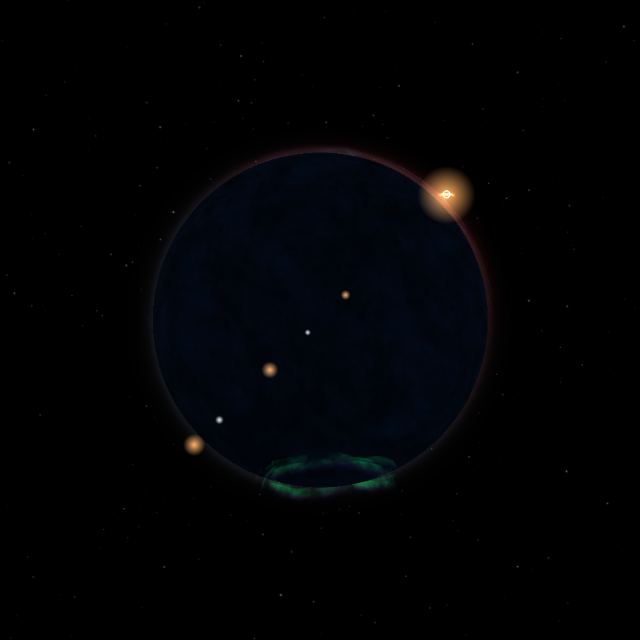
Janus
0
Water World
✦ MutaMagnetic FieldModerate Activity
Why is this a Water World?Your planet has abundant oxygen (34.0%) and hydrogen (14.6%), creating extensive water coverage while in the habitable temperature zone.
Water worlds have deep global oceans covering most or all of their surface. They form when planets have high water content and orbit in the habitable zone.
Classification Criteria:
✓ Oxygen: 34.0% + Hydrogen: 14.6% (water-forming elements)✓ Temperature: 343K (habitable range)✓ Distance: 13.10 AU (habitable zone)
Habitability ScoreExtremely Harsh
Contributing Factors
water90
Good water content
geology90
Active geology recycles nutrients and drives carbon cycle
rotation100
Optimal rotation period - balanced day/night cycle, moderate weather, and good heat distribution
Organic Chemistry80
Core organic elements (CHNO) present
atmosphere100
Nitrogen-oxygen atmosphere - breathable and protective
temperature70
Challenging but potentially habitable temperature
magnetic Field100
Magnetic field provides radiation protection — but the black hole's accretion disk bathes this orbit in hard X-ray radiation
Physical Properties
Mass
1.00x Earth (5.97e+24 kg)Radius
1.00x Earth (6,371 km)Surface Gravity
1.00x Earth (9.8 m/s²)Surface Temperature
343 K (70 °C / 159 °F)Rotation Period
20.0 hours/day (faster than Earth)Orbital Environment
Star Type
BH-type (Black Hole)Distance from Star
13.10 AU (1.96 billion km)Orbital Period
15.0 yearsAtmosphere
Nitrogen and oxygen with water vapor, mild greenhouse effect
Elemental Composition
O - Oxygen
34.0%
N - Nitrogen
31.1%
H - Hydrogen
14.6%
Surface Characteristics
Vast oceans covering most of the surface, scattered islands or archipelagosClosest Real Exoplanet
Kepler-54 c84% similar
Orbiting Kepler-54| Yours | Kepler-54 c | |
|---|---|---|
| Mass | 1.00 × Earth | 0.70 × Earth |
| Radius | 1.22 × Earth | 1.23 × Earth |
| Density (composition) | 3.00 g/cm³ | 2.07 g/cm³ |
| Temperature | 343.5 K | 395.0 K |
| Starlight received | 2.33 × Earth | 3.07 × Earth |
| Star temperature | — | 3,705 K |