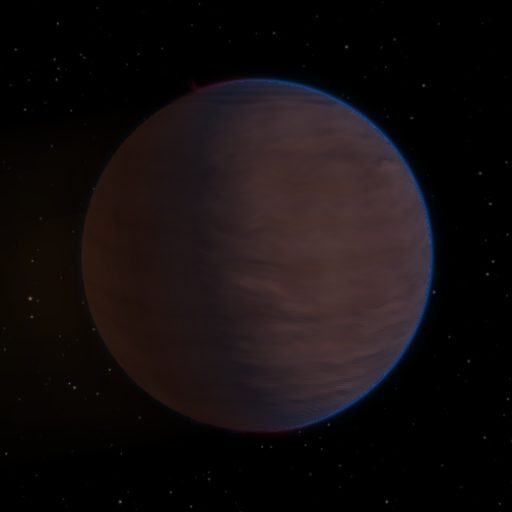
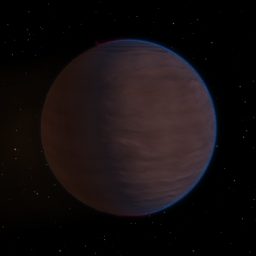
51 Peg b
Also written 51 Pegb
- Mass
- 194.00 × Earth
- Radius
- 14.10 × Earth
- Gravity
- 0.98 g
- Surface (est.)
- 1,321 K
- Year
- 4.2 days
- From Earth
- 50.6 ly
- Mass
- 194.00 × Earth
- Radius
- 14.10 × Earth
- Gravity
- 0.98 g
- Surface (est.)
- 1,321 K
- Year
- 4.2 days
- From Earth
- 50.6 ly
51 Peg system
- Type
- G-type (Yellow (Sun-like))
- Spectral type
- G5V
- Temperature
- 5,761 K
- Radius
- 1.19 ☉
- Mass
- 1.07 ☉
- Planets
- 2
- Luminosity
- 1.37 ☉
Published by the NASA Exoplanet Archive. This world’s temperature and habitability score are computed from this star’s measured luminosity, not from a stand-in for its class.
 51 Peg b0.052 AUYou are here194 M⊕
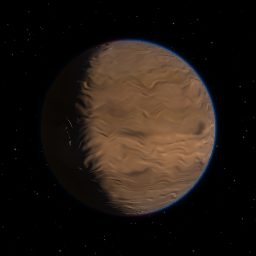
Star and planets drawn to scale: the star is 9.2 times as wide as 51 Peg b, so only its edge is in view. Orbits spaced as in the star system view.
Estimated: this planet doesn't transit its star, so its size is inferred, not measured
This is the planet that started the modern hunt for worlds around other suns. In October 1995, Swiss astronomers Michel Mayor and Didier Queloz announced the first planet found orbiting a Sun-like star. They used the ELODIE spectrograph at the Observatory of Haute-Provence in France. A spectrograph spreads starlight into its colours, which lets astronomers see the star wobble slightly toward and away from us as an unseen planet tugs on it. This is called the radial velocity method. Their paper appeared in Nature in November 1995, and the work later earned them the 2019 Nobel Prize in Physics.
Surface. No solid surface - thick gaseous envelope with possible rocky core deep within
Hydrogen and helium dominated with trace methane and ammonia
Hydrogen-rich atmosphere typical of gas giantsPhysical Properties
Time Dilation
Clocks run 9.0 seconds per year slower than deep space — about 12 minutes over a lifetimeElemental Composition
How TerraForge built this world
51 Peg b, from the NASA Exoplanet Archive (found 1995). Measured: 194 Earth masses, 0.052 AU, a 5761 K G-type star. Composition inferred from a mass of 194 Earths, which is giant territory whatever its 0.07x density suggests, with a day locked to its 4.2-day year, as anything orbiting this close would be.