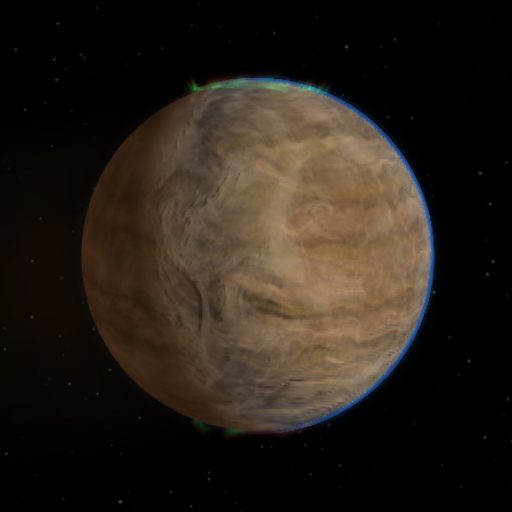
This is the planet that started the modern hunt for worlds around other suns. In October 1995, Swiss astronomers Michel Mayor and Didier Queloz announced the first planet found orbiting a Sun-like star. They used the ELODIE spectrograph at the Observatory of Haute-Provence in France. A spectrograph spreads starlight into its colours, which lets astronomers see the star wobble slightly toward and away from us as an unseen planet tugs on it. This is called the radial velocity method. Their paper appeared in Nature in November 1995, and the work later earned them the 2019 Nobel Prize in Physics.
The surprise was the orbit. 51 Pegasi b is a giant, roughly half the mass of Jupiter, yet it circles its star every 4.23 days at just 0.052 astronomical units. One astronomical unit is the distance from Earth to the Sun, so this planet sits about twenty times closer to its star than we do to ours. Giants on orbits like this became known as hot Jupiters.
Because the planet never passes in front of its star from our point of view, it is hard to study. In 2015 a team led by Jorge Martins used the HARPS spectrograph on ESO's 3.6-metre telescope at La Silla in Chile to pick out a faint copy of the star's light reflected off the planet. Their result pointed to a highly reflective planet, about half Jupiter's mass and probably larger than Jupiter. Earlier, in 2013, a team using the CRIRES instrument on ESO's Very Large Telescope reported carbon monoxide and water in the planet's dayside atmosphere.
Some of this is still unsettled. The 2013 signal showed up on two nights of observing but vanished on the third, and the authors said more data were needed before drawing firm conclusions. The planet's size has never been measured directly, since that normally requires watching it cross its star, so the radius on this page is an estimate. Mass estimates also vary: the archive lists about 194 Earth masses, while the 2013 study derived about 0.46 Jupiter masses, close to 146 Earth masses.
TerraForge's model, working only from the planet's mass, orbit and star, classifies it as a gas giant with a temperature near 1,320 kelvin and no chance of habitability. That matches what observations suggest: a large, reflective, scorching hot Jupiter.