Create your free account

Enter your email and we'll send a 6-digit code — no password needed.
We only keep your email and the username you choose. We never share or sell your email, and we don't send marketing — we use it only to email you a sign-in code. Read our privacy policy.
Entering orbit…
Habitability
0/ 100
Uninhabitable

Reading Elias 2-24 b’s atmosphere

Dominant elements: H, He, O, C, NThis is what a telescope would measure while Elias 2-24 b crosses in front of its star: starlight passes through the atmosphere and spreads into a rainbow band. Each dark line marks a wavelength the atmosphere absorbed.Every element absorbs its own signature wavelengths — hydrogen always darkens the same two spots, calcium another pair, and so on. Astronomers match the lines in a real spectrum against a library of these signatures to say what an atmosphere is made of, light-years away, without ever visiting. A deeper line generally means more of that element is present.Elias 2-24 b sits about 444 light-years away, found by the imaging method. Most catalogued distances trace back to parallax: as Earth orbits the Sun, a nearby star appears to shift very slightly against the distant background stars, and the size of that shift gives its distance directly.
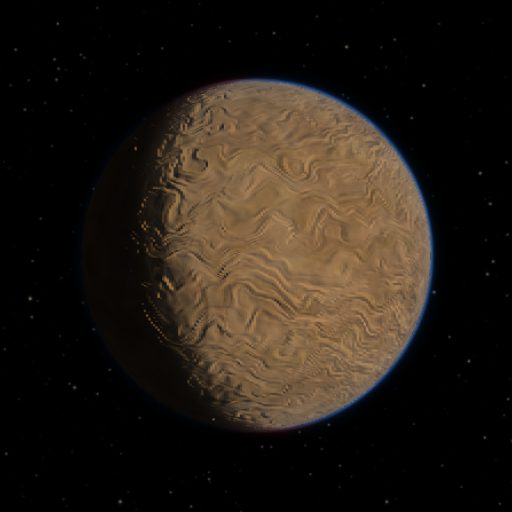
Elias 2-24 b rendered in TerraForge from its measured mass, orbit and star

Elias 2-24 b

Also written Elias 2-24b, Elias 2 24b, Elias 2 24 b

Gas GiantUninhabitable443 light years awayFound 2026

Estimated: this planet doesn't transit its star, so its size is inferred, not measured

Elias 2-24 b is reported as the youngest planet yet found outside the Solar System: the team that confirmed it estimates it is no more than about a million years old. It orbits a young star about 136 parsecs (roughly 440 light-years) away in the Ophiuchus star-forming region, and it is still embedded in the protoplanetary disk it formed from. A protoplanetary disk is the flattened ring of gas and dust that surrounds a newborn star and supplies the raw material for planets.

Read the full article

Host star

Elias 2-24

Type
K-type (Orange)
Spectral type
K6
Temperature
4,483 K
Mass
0.78 ☉
Known planets
1 (this one)

Published by the NASA Exoplanet Archive. This star’s luminosity has not been published, so this world’s temperature and habitability score fall back to a typical K-type star.

Gas Giant
Magnetic FieldExtreme Activity
Why is this a Gas Giant?Elias 2-24 b has 86.0% hydrogen and helium, combined with a mass of 938.0x Earth, which exceeds the gas giant threshold.
Gas giants form when massive cores capture enormous atmospheres of light gases. They typically form beyond the 'frost line' where volatiles can condense.
Classification Criteria:
✓ Hydrogen + Helium: 86.0% (>60% required)✓ Mass: 938.0x Earth (>10x required)
Habitability ScoreUninhabitable
0
Contributing Factors
temperature0
Near absolute zero - all molecular activity ceases, impossible for life
atmosphere30
Hydrogen-rich atmosphere typical of gas giants
water15
No solid surface — any water is locked in a supercritical mantle and hot ice, not oceans
magnetic Field100
Magnetic field provides radiation protection
geology40
Extreme volcanic activity may be hazardous
Organic Chemistry80
Core organic elements (CHNO) present
rotation100
Optimal rotation period - balanced day/night cycle, moderate weather, and good heat distribution

Physical Properties

Mass
938.00x Earth (5.60e+27 kg)
Radius
9.79x Earth (62,365 km)
This planet: 9.79× Earth radiusEarth: 1× (baseline)
Surface Gravity
9.79x Earth (96.0 m/s²)
Surface Temperature
30 K (-243 °C / -406 °F)
Rotation Period
24.0 hours/day
This planet: 24 h/dayEarth: 24 h/day

Orbital Environment

Star Type
K-type (Orange)
Distance from Star
54.90 AU (8.21 billion km)
Orbital Period
486.2 years

Atmosphere

Hydrogen and helium dominated with trace methane and ammonia

Elemental Composition

H - Hydrogen
53.8%
He - Helium
32.3%
O - Oxygen
5.4%

Surface Characteristics

No solid surface - thick gaseous envelope with possible rocky core deep within

How TerraForge built this world

Elias 2-24 b, from the NASA Exoplanet Archive (found 2026). Measured: 938 Earth masses, 54.9 AU, a 4483 K K-type star. Composition inferred from a mass of 938 Earths, which is giant territory whatever its 0.41x density suggests, with an assumed 24-hour day — rotation cannot be measured for exoplanets.

A banded gas giant with four moons in different colors: a yellow sulfur moon, two rust-red rock moons and a blue water moon

New: Choose What Your Moons Are Made Of 🌙

Every moon used to be grey rock, white ice or blue ocean, decided for you. Now each one has a "Made of" choice in the builder's Moons tab — silicate rock, iron, water ice, carbon, sulfur, or nitrogen and methane ice — and the physics decides what that becomes. Put water ice too close to the star and it boils off to bare rock. Put sulfur where a neighbouring moon keeps it tidally flexed and it erupts in Io's yellows. Give a Titan-sized moon nitrogen ice far from the sun and it wraps itself in haze. Hang a water moon about the mass of Earth off a giant planet in the habitable zone and it can hold air and open seas — scored for life on the same scale as a planet, with a day as long as its orbit. A tint slider nudges the colour, but only as far as that material could really go.

Create your free account

Enter your email and we'll send a 6-digit code — no password needed.
We only keep your email and the username you choose. We never share or sell your email, and we don't send marketing — we use it only to email you a sign-in code. Read our privacy policy.

Send feedback

We're still building out the best experience we can — and we'd love your input. Tell us about features you enjoy, ideas you'd like to see, or pain points where something feels off, and we'll know where to look next.

Type
Idea
Bug
Pain point
Other