Create your free account

Enter your email and we'll send a 6-digit code — no password needed.
We only keep your email and the username you choose. We never share or sell your email, and we don't send marketing — we use it only to email you a sign-in code. Read our privacy policy.
Exoplanet profiles

Elias 2-24 b

Gas Giant · 443 light-years away · Last reviewed October 16, 2026

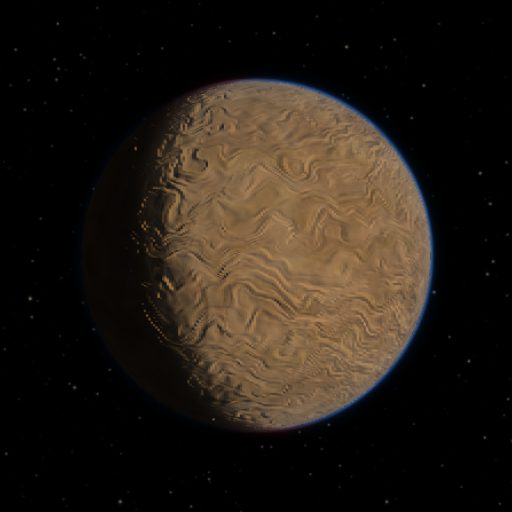
Elias 2-24 b rendered in TerraForge from its measured mass, orbit and star
TerraForge's rendering of Elias 2-24 b, generated by our physics engine from its measured mass, size, orbit and star. An illustration of what the science suggests, not a photograph.
TerraForge classification
Gas Giant. Estimated: this planet doesn't transit its star, so its size is inferred, not measured
Distance
443 light-years
Mass
938 × Earth
Radius
13.2 × Earth
Discovered
2026, imaging

Figures from the NASA Exoplanet Archive. The classification is TerraForge’s, from its physics model.

Elias 2-24 b is reported as the youngest planet yet found outside the Solar System: the team that confirmed it estimates it is no more than about a million years old. It orbits a young star about 136 parsecs (roughly 440 light-years) away in the Ophiuchus star-forming region, and it is still embedded in the protoplanetary disk it formed from. A protoplanetary disk is the flattened ring of gas and dust that surrounds a newborn star and supplies the raw material for planets.

Inside the clouds of Elias 2-24 b, illustrated by TerraForge
The view from within the clouds of Elias 2-24 b, as TerraForge's physics engine draws it from the planet's measured properties. An illustration, not a photograph.

The planet was confirmed in 2026 by a team led by A. Bernardi of Diego Portales University in Chile. Keck Observatory's NIRC2 camera, which uses a coronagraph to block the glare of the star, first recorded a faint signal from the system in 2018, but not enough to call it a planet. Re-processing those archived images with newer techniques, and adding a second Keck observation from 2020, recovered the source in the place where earlier studies with ESO's Very Large Telescope and the ALMA radio telescope array had reported a candidate. The team also showed it moves across the sky with the star, so it is not a distant background object.

What makes it notable is where it sits. ALMA images show the disk split by dark rings called gaps, and Elias 2-24 b lies inside one of them, about 55 astronomical units from its star (one astronomical unit is the Earth–Sun distance). Astronomers have long suspected that young planets carve such gaps, and this is one of the clearest cases of a planet found in one. The authors argue it formed by core accretion, where a solid core grows first and then pulls in gas, and that it shows a giant planet can form this way about 50 astronomical units out within roughly a million years.

Much is still uncertain. Ages for stars this young are notoriously hard to pin down, and the authors note the system may be even younger. Comparing the planet's brightness with models gives a mass between 1.9 and 4.0 times Jupiter's, but that range ignores the extra light from material falling onto the planet; because it is probably still accreting vigorously, the team favours the lower end. Its temperature is estimated at roughly 1,100 to 2,000 kelvin. The two Keck images are too close in time to show the planet moving along its orbit, so its orbit is not yet measured, and the team hopes future observations will tighten its mass and reveal more about its atmosphere.

Sources

  1. Searching for Embedded Protoplanets with the Keck/NIRC2 Vortex Coronagraph: Confirmation of a Core-accretion Planet in the Narrow Gap of the Elias 2-24 Disk — arXiv (The Astrophysical Journal Letters)
  2. Youngest Exoplanet Yet Discovered Found Hiding in Keck Observatory Data — W. M. Keck Observatory
  3. Elias 2-24 b — NASA Exoplanet Archive
A banded gas giant with four moons in different colors: a yellow sulfur moon, two rust-red rock moons and a blue water moon

New: Choose What Your Moons Are Made Of 🌙

Every moon used to be grey rock, white ice or blue ocean, decided for you. Now each one has a "Made of" choice in the builder's Moons tab — silicate rock, iron, water ice, carbon, sulfur, or nitrogen and methane ice — and the physics decides what that becomes. Put water ice too close to the star and it boils off to bare rock. Put sulfur where a neighbouring moon keeps it tidally flexed and it erupts in Io's yellows. Give a Titan-sized moon nitrogen ice far from the sun and it wraps itself in haze. Hang a water moon about the mass of Earth off a giant planet in the habitable zone and it can hold air and open seas — scored for life on the same scale as a planet, with a day as long as its orbit. A tint slider nudges the colour, but only as far as that material could really go.

Create your free account

Enter your email and we'll send a 6-digit code — no password needed.
We only keep your email and the username you choose. We never share or sell your email, and we don't send marketing — we use it only to email you a sign-in code. Read our privacy policy.

Send feedback

We're still building out the best experience we can — and we'd love your input. Tell us about features you enjoy, ideas you'd like to see, or pain points where something feels off, and we'll know where to look next.

Type
Idea
Bug
Pain point
Other