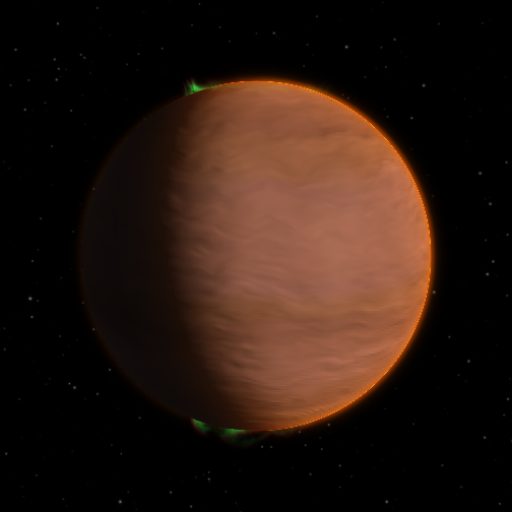
GJ 1214 b
Also written GJ 1214b
- Mass
- 8.41 × Earth
- Radius
- 2.73 × Earth
- Gravity
- 1.13 g
- Surface (est.)
- 576 K
- Year
- 37.9 hrs
- From Earth
- 47.6 ly
- Mass
- 8.41 × Earth
- Radius
- 2.73 × Earth
- Gravity
- 1.13 g
- Surface (est.)
- 576 K
- Year
- 37.9 hrs
- From Earth
- 47.6 ly
GJ 1214 system
- Type
- M-type (Red Dwarf)
- Spectral type
- M4 V
- Temperature
- 3,101 K
- Radius
- 0.216 ☉
- Mass
- 0.182 ☉
- Planets
- 1
- Luminosity
- 3.90e-3 ☉
Published by the NASA Exoplanet Archive. This world’s temperature and habitability score are computed from this star’s measured luminosity, not from a stand-in for its class.
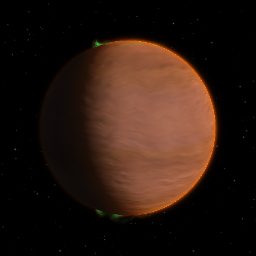 GJ 1214 b0.015 AUYou are here8.4 M⊕
Star and planets drawn to scale: the star is 8.6 times as wide as GJ 1214 b, so only its edge is in view. Orbits spaced as in the star system view.
Planets between Earth and Neptune in size, called sub-Neptunes, are the most common type in our galaxy, yet our Solar System has none. GJ 1214 b is one of the most closely studied. It was found in 2009 by the MEarth survey using the transit method, which looks for a small, regular dip in a star's light as a planet crosses in front. Its star is a small red dwarf about 48 light-years away, so the planet blocks a relatively large share of its light. That makes its atmosphere easier to probe. Its official name, Enaiposha, means "large body of water" in the Maasai language.
Surface. No solid surface - a hydrogen-helium envelope wrapped around a rocky core (a sub-Neptune)

Deep hydrogen-helium envelope with photochemical haze
Hydrogen-rich atmosphere typical of gas giantsPhysical Properties
Time Dilation
Clocks run 9.3 seconds per year slower than deep space — about 12 minutes over a lifetimeElemental Composition
How TerraForge built this world
GJ 1214 b, from the NASA Exoplanet Archive (found 2009). Measured: 8.41 Earth masses, 0.015 AU, a 3101 K M-type star. Composition inferred from a measured bulk density of 0.41x Earth's, too low for bare rock at this size, suggesting a rocky core under roughly a 6% hydrogen/helium envelope by mass, with a day locked to its 1.6-day year, as anything orbiting this close would be.