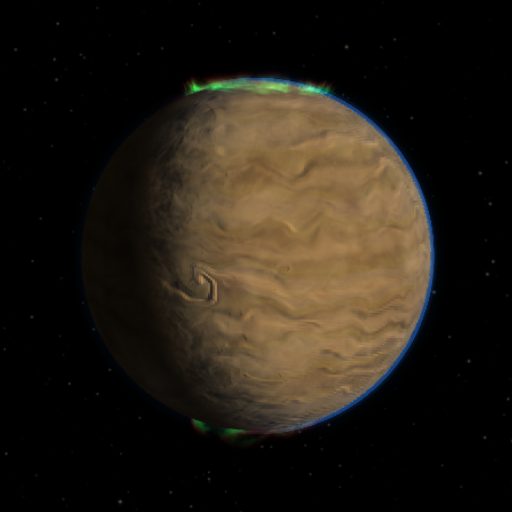
Planets between Earth and Neptune in size, called sub-Neptunes, are the most common type in our galaxy, yet our Solar System has none. GJ 1214 b is one of the most closely studied. It was found in 2009 by the MEarth survey using the transit method, which looks for a small, regular dip in a star's light as a planet crosses in front. Its star is a small red dwarf about 48 light-years away, so the planet blocks a relatively large share of its light. That makes its atmosphere easier to probe. Its official name, Enaiposha, means "large body of water" in the Maasai language.
For years, its atmosphere hid behind haze. In 2014 Hubble observations led by Laura Kreidberg found a featureless spectrum, meaning the starlight filtering through the atmosphere showed none of the expected chemical fingerprints. That ruled out a clear atmosphere and pointed to high clouds. In 2023 a team led by Eliza Kempton used the James Webb Space Telescope's MIRI instrument to follow the planet around its whole orbit. They measured a day side near 553 K and a night side near 437 K, and found the planet reflects about half the light that hits it. Their models favour a high-metallicity atmosphere, meaning rich in elements heavier than hydrogen and helium, under a thick, bright layer of cloud or haze.
In 2024 and 2025 teams led by Everett Schlawin and Kazumasa Ohno used Webb's NIRSpec instrument and reported possible carbon dioxide and methane. Their best-fitting models describe a carbon-dioxide-rich world they call a super-Venus.
That result is tentative. The signal is small, and a model with both gases is preferred over a flat spectrum at 3.3 to 3.6 sigma, short of the 5 sigma usually treated as a firm detection. The authors say more observations are needed to confirm it. Before Webb, astronomers debated whether GJ 1214 b is a rocky planet wrapped in hydrogen or an icy, water-rich world. Its interior is still unknown.
TerraForge's model, working only from its mass, orbit and star, classifies GJ 1214 b as an ice giant, close to the older water-world idea, and its modelled 596 K sits near the measured day side. Observations now point to a heavy, hazy, possibly carbon-rich atmosphere, which a model built from mass and orbit alone cannot detect.