
GJ 143 b
Also written GJ 143b
- Mass
- 25.90 × Earth
- Radius
- 2.81 × Earth
- Gravity
- 3.28 g
- Surface (est.)
- 465 K
- Year
- 35.6 days
- From Earth
- 53.2 ly
- Mass
- 25.90 × Earth
- Radius
- 2.81 × Earth
- Gravity
- 3.28 g
- Surface (est.)
- 465 K
- Year
- 35.6 days
- From Earth
- 53.2 ly
GJ 143 system
- Type
- K-type (Orange)
- Spectral type
- K4 V
- Temperature
- 4,675 K
- Radius
- 0.709 ☉
- Mass
- 0.726 ☉
- Planets
- 2
- Luminosity
- 0.215 ☉
Published by the NASA Exoplanet Archive. This world’s temperature and habitability score are computed from this star’s measured luminosity, not from a stand-in for its class.
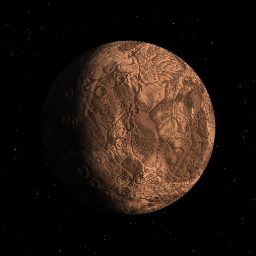
 GJ 143 b0.19 AUYou are here26 M⊕
Star and planets drawn to scale: the star is 28 times as wide as GJ 143 b, so only its edge is in view. Orbits spaced as in the star system view.
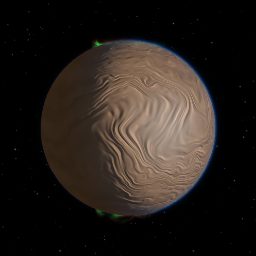
GJ 143 b, from the NASA Exoplanet Archive (found 2019). Measured: 25.9 Earth masses, 0.19 AU, a 4675 K K-type star. Composition inferred from a measured bulk density of 1.17x Earth's at this size, suggesting roughly 25% water/ice by mass, with an assumed 24-hour day — rotation cannot be measured for exoplanets.
Surface. No solid surface - a deep volatile envelope over a supercritical water mantle and hot-ice interior




Hydrogen and helium with water, methane, and ammonia ices
Hydrogen-rich atmosphere typical of gas giants