Habitability
5/ 100
View planet
View star system
View surface
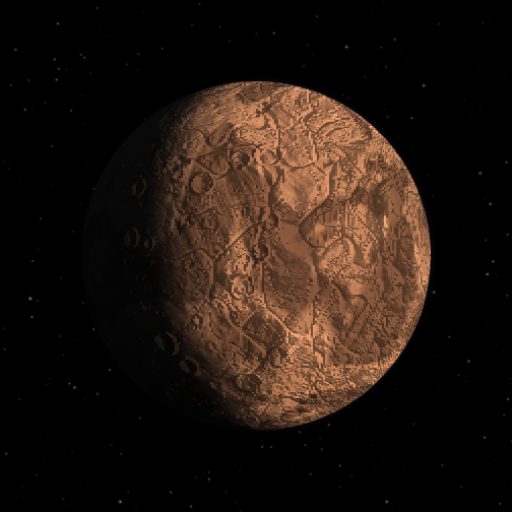
HD 21749 c
Also written HD 21749c
Rocky Terrestrial53 light years awayFound 2019
- Mass
- 1.43 × Earth
- Radius
- 0.98 × Earth
- Gravity
- 1.48 g
- Surface (est.)
- 731 K
- Year
- 7.8 days
- From Earth
- 53.2 ly
- Mass
- 1.43 × Earth
- Radius
- 0.98 × Earth
- Gravity
- 1.48 g
- Surface (est.)
- 731 K
- Year
- 7.8 days
- From Earth
- 53.2 ly
GJ 143 system
- Type
- K-type (Orange)
- Spectral type
- K4 V
- Temperature
- 4,675 K
- Radius
- 0.709 ☉
- Mass
- 0.726 ☉
- Planets
- 2
- Luminosity
- 0.215 ☉
Published by the NASA Exoplanet Archive. This world’s temperature and habitability score are computed from this star’s measured luminosity, not from a stand-in for its class.
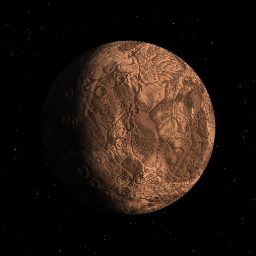 HD 21749 c0.069 AUYou are here1.4 M⊕
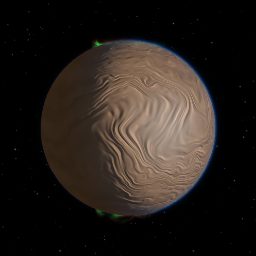
Habitable zone
Star and planets drawn to scale: the star is 79 times as wide as HD 21749 c, so only its edge is in view. Orbits spaced as in the star system view.
HD 21749 c, from the NASA Exoplanet Archive (found 2019). Measured: 1.43 Earth masses, 0.0691 AU, a 4675 K K-type star. Composition inferred from a measured bulk density of 1.50x Earth's, which is rock and iron, with a day locked to its 7.8-day year, as anything orbiting this close would be.
Surface. Rocky surface with impact craters, possible volcanic features
Rocky Terrestrial
Life unlikely — too hot for liquid waterModerate Activity
Rocky terrestrial planets are primarily composed of silicate rocks and metals. They're the most common type of small planet in the universe.
Classification Criteria:
✓ Silicon: 25.0% + Iron: 12.5% + Magnesium: 3.8%✓ Mass: 1.4x Earth (terrestrial range)


Habitability ScoreUninhabitable
Contributing Factors
temperature3
Scorching - hot enough to melt lead, though rock stays solid; no chance for life
atmosphere70
Thin CO₂ and nitrogen atmosphere
Nitrogen atmosphere provides protection but not breathablewater8
Limited water content - boiling away, little would be retained
magnetic Field30
No magnetic field - vulnerable to solar radiation
geology90
Active geology recycles nutrients and drives carbon cycle
Organic Chemistry80
Core organic elements (CHNO) present
rotation30
Very slow rotation - days and nights each last several Earth days, bringing extreme temperature swings
Physical Properties
Mass
1.43x Earth (8.54e+24 kg)Radius
1.13x Earth (7,178 km)Surface Gravity
1.13x Earth (11.1 m/s²)Surface Temperature
731 K (458 °C / 856 °F)Rotation Period
187.0 hours/day (slower than Earth)