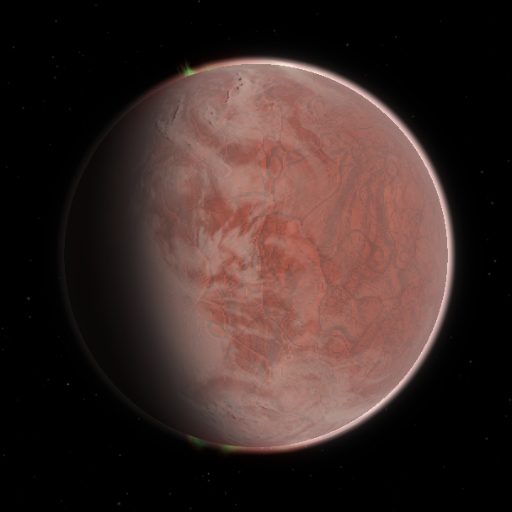
GJ 667 C b
Also written GJ 667 Cb
- Mass
- 5.68 × Earth
- Radius (est.)
- 2.25 × Earth
- Gravity (est.)
- 1.12 g
- Surface (est.)
- 430 K
- Year
- 7.2 days
- From Earth
- 23.6 ly
- Mass
- 5.68 × Earth
- Radius (est.)
- 2.25 × Earth
- Gravity (est.)
- 1.12 g
- Surface (est.)
- 430 K
- Year
- 7.2 days
- From Earth
- 23.6 ly
GJ 667 C system
- Type
- M-type (Red Dwarf)
- Spectral type
- M1.5 V
- Temperature
- 3,350 K
- Mass
- 0.33 ☉
- Planets
- 5
- Luminosity
- 0.0137 ☉
Published by the NASA Exoplanet Archive. This world’s temperature and habitability score are computed from this star’s measured luminosity, not from a stand-in for its class.
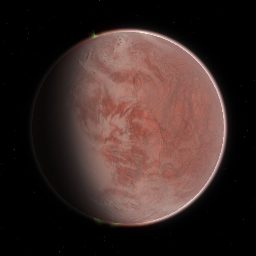 GJ 667 C b0.050 AUYou are here5.7 M⊕
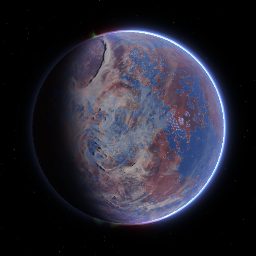
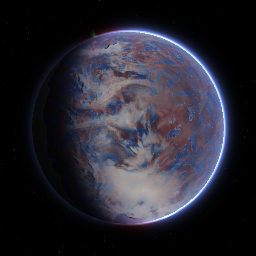
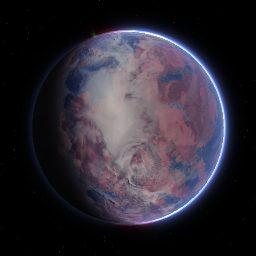
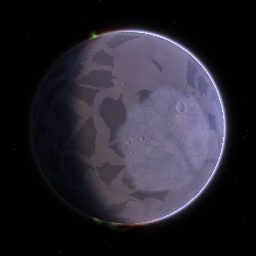
Planets drawn to scale with each other; the star's size is not measured. Orbits spaced as in the star system view.
Estimated: this planet doesn't transit its star, so its size is inferred, not measured
GJ 667 C b is the innermost planet of GJ 667 C, a red dwarf about 24 light-years away that belongs to a triple star system: it travels with a pair of stars, GJ 667 A and B. The planet orbits every 7.2 days and has a minimum mass of about 5.7 Earth masses, making it a super-Earth, heavier than Earth but lighter than Neptune.
Surface. Rocky surface with impact craters, possible volcanic features

Thin CO₂ and nitrogen atmosphere
Nitrogen atmosphere provides protection but not breathablePhysical Properties
Elemental Composition
How TerraForge built this world
GJ 667 C b, from the NASA Exoplanet Archive (found 2012). Measured: 5.68 Earth masses, 0.0504 AU, a 3350 K M-type star. Composition inferred from an estimated bulk density of 0.50x Earth's, modeled rather than measured since this isn't a transiting planet — an envelope can't be inferred from estimated figures, so it is read as rock and iron, with a day locked to its 7.2-day year, as it is predicted to be tidally locked: at this distance its star would have stopped its spin within a million years.