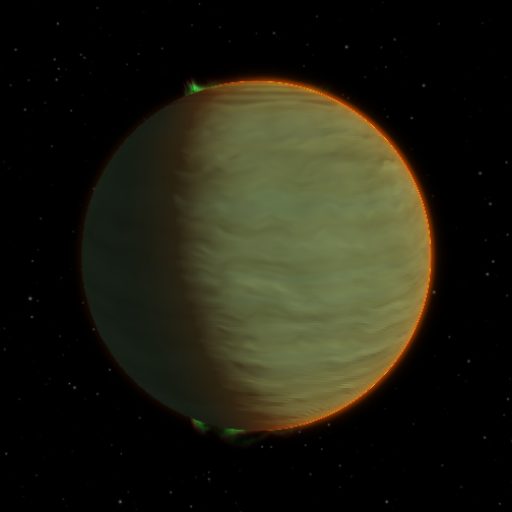
GJ 887 c
Also written GJ 887c
- Mass
- 6.50 × Earth
- Radius
- 2.43 × Earth
- Gravity
- 1.10 g
- Surface (est.)
- 355 K
- Year
- 21.8 days
- From Earth
- 10.7 ly
- Mass
- 6.50 × Earth
- Radius
- 2.43 × Earth
- Gravity
- 1.10 g
- Surface (est.)
- 355 K
- Year
- 21.8 days
- From Earth
- 10.7 ly
GJ 887 system
- Type
- M-type (Red Dwarf)
- Spectral type
- M1 V
- Temperature
- 3,688 K
- Radius
- 0.468 ☉
- Mass
- 0.495 ☉
- Planets
- 4
- Luminosity
- 0.0368 ☉
Published by the NASA Exoplanet Archive. This world’s temperature and habitability score are computed from this star’s measured luminosity, not from a stand-in for its class.
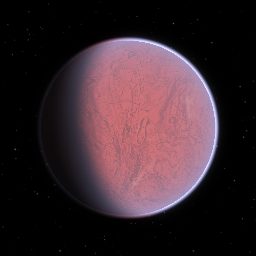
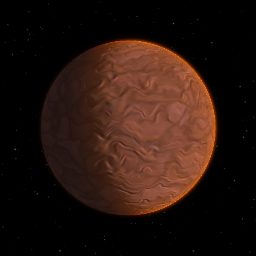
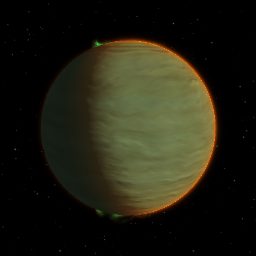
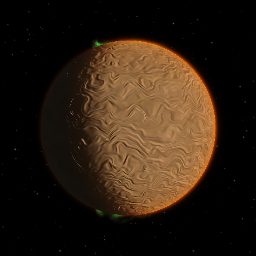
Star and planets drawn to scale: the star is 21 times as wide as GJ 887 c, so only its edge is in view. Orbits spaced as in the star system view.
Estimated: this planet doesn't transit its star, so its size is inferred, not measured
GJ 887 c is a super-Earth, a planet heavier than Earth but lighter than Neptune, orbiting the brightest red dwarf in our sky, about 10.7 light-years away. It was discovered together with its inner neighbour GJ 887 b and announced in the journal Science in 2020 by the RedDots team, led by Sandra Jeffers at the University of Göttingen. They used HARPS, a spectrograph at the European Southern Observatory's La Silla Observatory, and the radial velocity method, which finds planets from the small back-and-forth motion their gravity gives the star.
Surface. No solid surface - a hydrogen-helium envelope wrapped around a rocky core (a sub-Neptune)

Deep hydrogen-helium envelope with photochemical haze
Hydrogen-rich atmosphere typical of gas giantsPhysical Properties
Elemental Composition
How TerraForge built this world
GJ 887 c, from the NASA Exoplanet Archive (found 2020). Measured: 6.5 Earth masses, 0.121 AU, a 3688 K M-type star. Composition inferred from a estimated bulk density of 0.45x Earth's, modeled rather than measured since this isn't a transiting planet, too low for bare rock at this size, suggesting a rocky core under roughly a 4% hydrogen/helium envelope by mass, with an assumed 24-hour day — rotation cannot be measured for exoplanets.