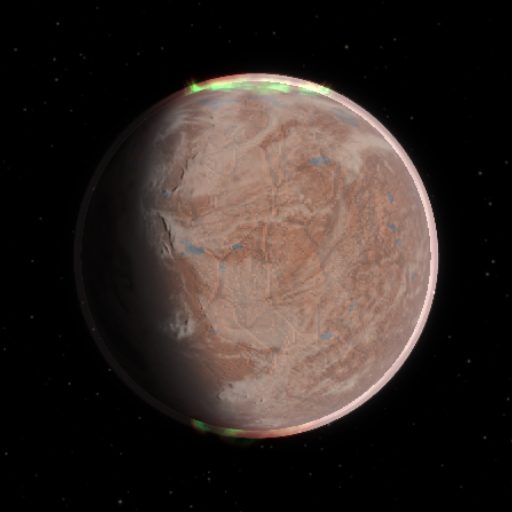
GJ 887 c is a super-Earth, a planet heavier than Earth but lighter than Neptune, orbiting the brightest red dwarf in our sky, about 10.7 light-years away. It was discovered together with its inner neighbour GJ 887 b and announced in the journal Science in 2020 by the RedDots team, led by Sandra Jeffers at the University of Göttingen. They used HARPS, a spectrograph at the European Southern Observatory's La Silla Observatory, and the radial velocity method, which finds planets from the small back-and-forth motion their gravity gives the star.
It completes an orbit every 21.8 days and has a minimum mass of about six and a half Earth masses. What drew attention to it is where that orbit sits. Assuming it reflects light like Earth, the discovery paper estimated an equilibrium temperature, set by starlight alone, of about 350 kelvin. That places it just inside the inner edge of the habitable zone, the range of distances where liquid water could last on a surface: close to it, but probably too warm.
Its star helps make it a good target for study. GJ 887 is unusually quiet for a red dwarf, with brightness changes below 500 parts per million, so its planets are less likely to have their atmospheres stripped by flares and its light is steady enough to follow a planet's own light as it moves around its orbit. In 2026 a team led by C. Hartogh added more than 100 new measurements, refined GJ 887 c's period to 21.784 days, and confirmed two more planets: GJ 887 d, further out in the habitable zone, and GJ 887 e, closer in. GJ 887 c does not pass in front of its star, so its size and true mass remain unknown.