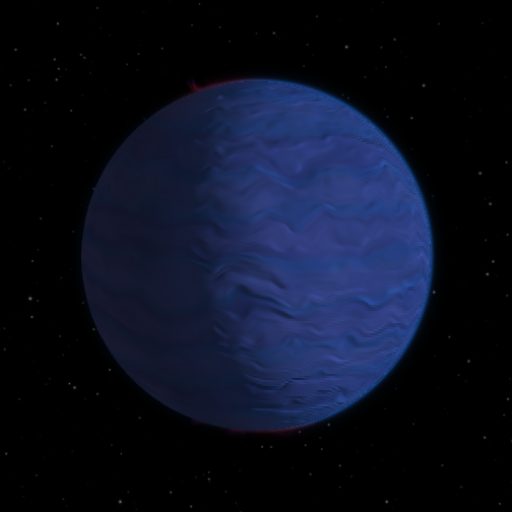
HD 189733 b
Also written HD 189733b
- Mass
- 359.00 × Earth
- Radius
- 12.70 × Earth
- Gravity
- 2.23 g
- Surface (est.)
- 1,208 K
- Year
- 2.2 days
- From Earth
- 64.6 ly
- Mass
- 359.00 × Earth
- Radius
- 12.70 × Earth
- Gravity
- 2.23 g
- Surface (est.)
- 1,208 K
- Year
- 2.2 days
- From Earth
- 64.6 ly
HD 189733 system
- Type
- K-type (Orange)
- Spectral type
- K2 V
- Temperature
- 5,052 K
- Radius
- 0.75 ☉
- Mass
- 0.79 ☉
- Planets
- 1
- Luminosity
- 0.346 ☉
Published by the NASA Exoplanet Archive. This world’s temperature and habitability score are computed from this star’s measured luminosity, not from a stand-in for its class.
 HD 189733 b0.031 AUYou are here359 M⊕
Star and planets drawn to scale: the star is 6.4 times as wide as HD 189733 b, so only its edge is in view. Orbits spaced as in the star system view.
Estimated: this planet doesn't transit its star, so its size is inferred, not measured
If you could see this planet up close, it would look a deep azure blue. In 2013 astronomers used the Hubble Space Telescope to measure its colour, by tracking how the system's light dropped as the planet slipped behind its star. The light fell most in blue wavelengths. The colour is not from oceans. It is thought to come from a hazy atmosphere laced with silicate particles, tiny grains of glass that scatter blue light. Winds there are estimated at 7,000 kilometres per hour.
Surface. No solid surface - thick gaseous envelope with possible rocky core deep within


Hydrogen and helium dominated with trace methane and ammonia
Hydrogen-rich atmosphere typical of gas giantsPhysical Properties
Time Dilation
Clocks run 10.5 seconds per year slower than deep space — about 14 minutes over a lifetimeElemental Composition
How TerraForge built this world
HD 189733 b, from the NASA Exoplanet Archive (found 2005). Measured: 359 Earth masses, 0.0313 AU, a 5052 K K-type star. Composition inferred from a mass of 359 Earths, which is giant territory whatever its 0.18x density suggests, with a day locked to its 2.2-day year, as anything orbiting this close would be.