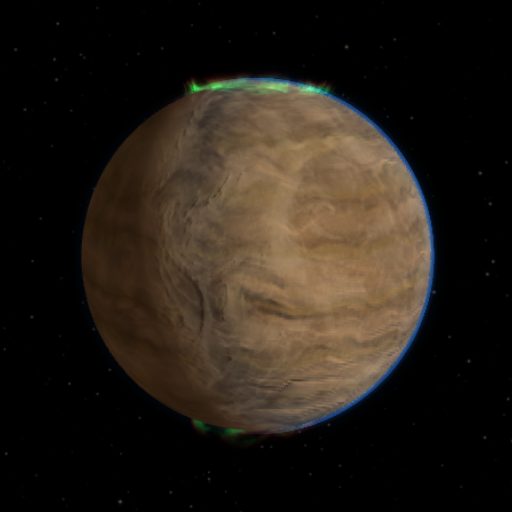
If you could see this planet up close, it would look a deep azure blue. In 2013 astronomers used the Hubble Space Telescope to measure its colour, by tracking how the system's light dropped as the planet slipped behind its star. The light fell most in blue wavelengths. The colour is not from oceans. It is thought to come from a hazy atmosphere laced with silicate particles, tiny grains of glass that scatter blue light. Winds there are estimated at 7,000 kilometres per hour.
The planet was announced in 2005 by a team using the ELODIE spectrograph and a 1.20-metre telescope camera at the Haute-Provence Observatory in France. They measured the star's wobble and also watched the planet transit, or pass in front of, its star. It blocked about 3 percent of the starlight, the deepest transit seen at the time. Because the star is bright and only about 65 light-years away, the discoverers expected it to be ideal for studying an atmosphere. It became just that. It circles its star every 2.22 days at 0.0313 astronomical units.
In 2024 a team led by Guangwei Fu used the James Webb Space Telescope to report water, carbon dioxide, carbon monoxide and hydrogen sulfide, the gas that makes rotten eggs smell. It was the first time hydrogen sulfide had been detected in an exoplanet's atmosphere. They found no methane, and measured heavy elements at three to five times the level in the planet's star. They argue this means the young planet swallowed many water-rich, icy building blocks as it formed.
Some questions remain. The hydrogen sulfide signal is weaker than the others, reported at a lower statistical confidence than water or carbon dioxide. The formation story is an interpretation of the measured gases, not something observed directly. Even the planet's colour came with a caveat from its discoverers, who noted that atmospheric colours are hard to pin down even for planets in our own Solar System.
TerraForge's model, using only mass, orbit and star, classifies it as a gas giant at about 1,210 kelvin with no habitability. That agrees with the observations; what the model cannot capture is the blue haze, glassy clouds and sulfur chemistry that make this planet distinctive.