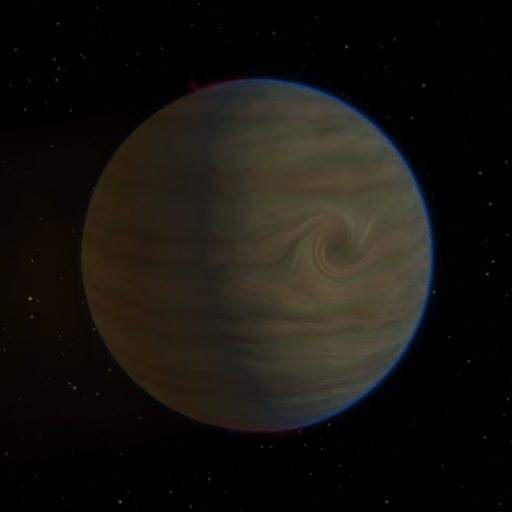
HD 209458 b
Also written HD 209458b
- Mass
- 232.00 × Earth
- Radius
- 15.60 × Earth
- Gravity
- 0.95 g
- Surface (est.)
- 1,465 K
- Year
- 3.5 days
- From Earth
- 158 ly
- Mass
- 232.00 × Earth
- Radius
- 15.60 × Earth
- Gravity
- 0.95 g
- Surface (est.)
- 1,465 K
- Year
- 3.5 days
- From Earth
- 158 ly
HD 209458 system
- Type
- F-type (White)
- Spectral type
- G0 V
- Temperature
- 6,091 K
- Radius
- 1.19 ☉
- Mass
- 1.23 ☉
- Planets
- 1
- Luminosity
- 1.70 ☉
Published by the NASA Exoplanet Archive. This world’s temperature and habitability score are computed from this star’s measured luminosity, not from a stand-in for its class.
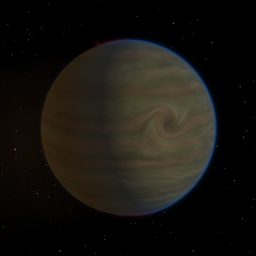 HD 209458 b0.047 AUYou are here232 M⊕
Star and planets drawn to scale: the star is 8.3 times as wide as HD 209458 b, so only its edge is in view. Orbits spaced as in the star system view.
Estimated: this planet doesn't transit its star, so its size is inferred, not measured
Much of what astronomers know how to do with exoplanet atmospheres was first tried on this world. In 1999 it was already known from the radial velocity method, which detects a star's slight wobble as a planet pulls on it. That year David Charbonneau and colleagues caught the planet passing in front of its star, dimming it slightly. It was the first time anyone had seen a planet transit, or cross the face of, a star like the Sun. The transit revealed the planet's size directly, about 1.27 times Jupiter's radius, and showed it was a gas giant.
Surface. No solid surface - thick gaseous envelope with possible rocky core deep within


Hydrogen and helium dominated with trace methane and ammonia
Hydrogen-rich atmosphere typical of gas giantsPhysical Properties
Time Dilation
Clocks run 12.9 seconds per year slower than deep space — about 17 minutes over a lifetimeElemental Composition
How TerraForge built this world
HD 209458 b, from the NASA Exoplanet Archive (found 1999). Measured: 232 Earth masses, 0.0471 AU, a 6091 K F-type star. Composition inferred from a mass of 232 Earths, which is giant territory whatever its 0.06x density suggests, with a day locked to its 3.5-day year, as anything orbiting this close would be.