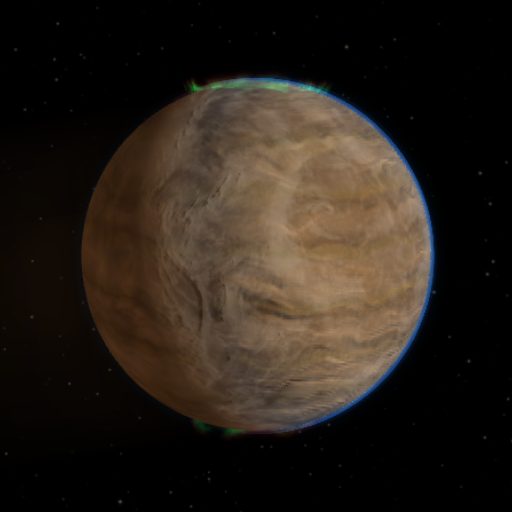
Much of what astronomers know how to do with exoplanet atmospheres was first tried on this world. In 1999 it was already known from the radial velocity method, which detects a star's slight wobble as a planet pulls on it. That year David Charbonneau and colleagues caught the planet passing in front of its star, dimming it slightly. It was the first time anyone had seen a planet transit, or cross the face of, a star like the Sun. The transit revealed the planet's size directly, about 1.27 times Jupiter's radius, and showed it was a gas giant.
A transit does more than reveal size. As starlight filters through the edge of the planet's atmosphere, gases in that thin ring absorb particular colours. In 2001 Charbonneau's team used the Hubble Space Telescope to report extra dimming at the colour absorbed by sodium. It was described as the first detection of an exoplanet's atmosphere. In 2003 a team led by Alfred Vidal-Madjar used Hubble to find a huge cloud of hydrogen around the planet, trailing behind it like a comet's tail. They estimated at least 10,000 tonnes of gas escape every second, so the planet may already have lost a great deal of its mass.
The cause is the planet's orbit. It circles its star every 3.52 days at 0.0471 astronomical units, about 7 million kilometres. For comparison, Jupiter sits about 780 million kilometres from the Sun. The archive puts the planet's equilibrium temperature, the temperature it would reach just from absorbing starlight, at about 1,460 kelvin.
The famous sodium result is now contested. The 2001 study already found less sodium than simple models predicted. In 2020, a team using the HARPS-N and CARMENES spectrographs reported no detectable sodium at all. They argued that the earlier signal could be explained by two effects of the star itself: its disc is brighter at the centre than the edges, and its rotation shifts the light blocked by the planet. If they are right, other atmosphere detections made the same way may also need checking. Both sides agree the planet has an atmosphere; the question is what it contains.
TerraForge's model, using only the planet's mass, orbit and star, classifies it as a gas giant at about 1,465 kelvin with no habitability. Observations agree, and add something the model cannot show: an atmosphere that is slowly boiling away.