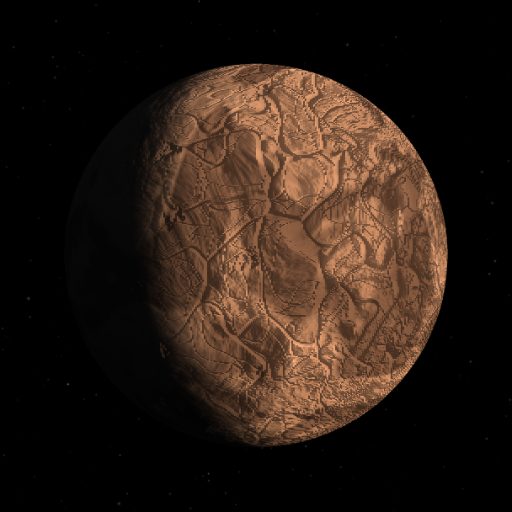
HD 219134 f
Also written HD 219134f
- Mass
- 7.30 × Earth
- Radius (est.)
- 1.71 × Earth
- Gravity (est.)
- 2.50 g
- Surface (est.)
- 540 K
- Year
- 22.7 days
- From Earth
- 21.3 ly
- Mass
- 7.30 × Earth
- Radius (est.)
- 1.71 × Earth
- Gravity (est.)
- 2.50 g
- Surface (est.)
- 540 K
- Year
- 22.7 days
- From Earth
- 21.3 ly
HD 219134 system
- Type
- K-type (Orange)
- Spectral type
- K3 V
- Temperature
- 4,798 K
- Radius
- 0.753 ☉
- Mass
- 0.779 ☉
- Planets
- 6
- Luminosity
- 0.271 ☉
Published by the NASA Exoplanet Archive. This world’s temperature and habitability score are computed from this star’s measured luminosity, not from a stand-in for its class.
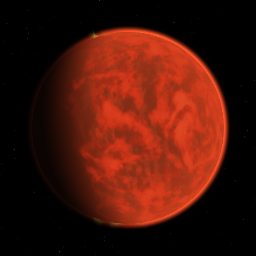
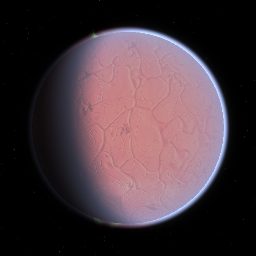
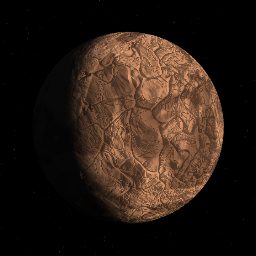 HD 219134 f0.14 AUYou are here7.3 M⊕
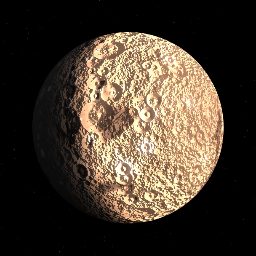
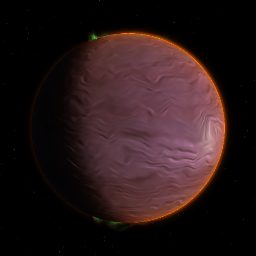
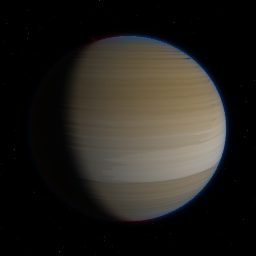
Star and planets drawn to scale: the star is 48 times as wide as HD 219134 f, so only its edge is in view. Orbits spaced as in the star system view.
Estimated: this planet doesn't transit its star, so its size is inferred, not measured
HD 219134 f is a super-Earth on a 22.7-day orbit around HD 219134, an orange dwarf star about 21 light-years away with up to six reported planets. Unlike its inner siblings HD 219134 b and c, it has never been seen crossing in front of its star, so only its minimum mass is known: about seven Earth masses, according to the NASA Exoplanet Archive.
Surface. Rocky surface with impact craters, possible volcanic features

Thin CO₂ and nitrogen atmosphere
Nitrogen atmosphere provides protection but not breathablePhysical Properties
Elemental Composition
How TerraForge built this world
HD 219134 f, from the NASA Exoplanet Archive (found 2015). Measured: 7.3 Earth masses, 0.142 AU, a 4798 K K-type star. Composition inferred from an estimated bulk density of 1.46x Earth's, modeled rather than measured since this isn't a transiting planet — the radius is the archive's estimate, so it can't settle how much water there is; read as rock and iron, with a day locked to its 22.7-day year, as it is predicted to be tidally locked: at this distance its star would have stopped its spin within 2 million years.