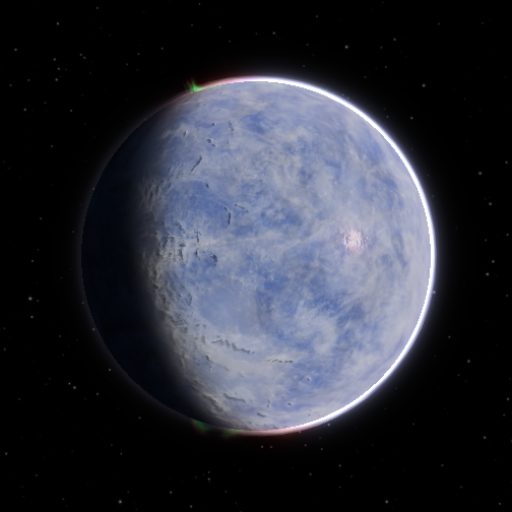
K2-3 d
Also written K2-3d, K2 3d, K2 3 d
- Mass
- 2.20 × Earth
- Radius
- 1.46 × Earth
- Gravity
- 1.03 g
- Surface (est.)
- 337 K
- Year
- 44.6 days
- From Earth
- 144 ly
- Mass
- 2.20 × Earth
- Radius
- 1.46 × Earth
- Gravity
- 1.03 g
- Surface (est.)
- 337 K
- Year
- 44.6 days
- From Earth
- 144 ly
K2-3 system
- Type
- K-type (Orange)
- Spectral type
- M V
- Temperature
- 3,844 K
- Radius
- 0.546 ☉
- Mass
- 0.549 ☉
- Planets
- 3
- Luminosity
- 0.0587 ☉
Published by the NASA Exoplanet Archive. This world’s temperature and habitability score are computed from this star’s measured luminosity, not from a stand-in for its class.
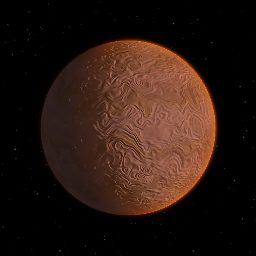
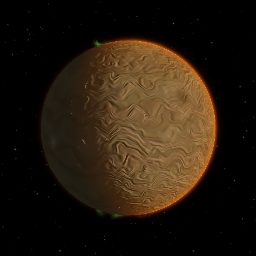
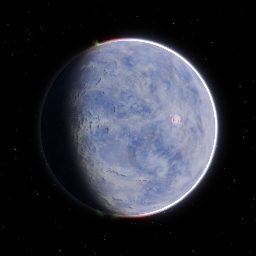
Star and planets drawn to scale: the star is 41 times as wide as K2-3 d, so only its edge is in view. Orbits spaced as in the star system view.
Water-Rich, likely · its density could also fit a sub-Neptune
K2-3 d is the outermost of three small planets crossing in front of K2-3, a red dwarf about 144 light-years away. It orbits every 44.6 days and is about 1.5 times Earth's width. In 2015 the team that discovered it, led by Ian Crossfield, noted that it sits near the inner edge of the star's habitable zone, the range of distances where liquid water could last on a surface.
Surface. Vast oceans covering most of the surface, scattered islands or archipelagos
✓ Conditions could support life. This planet’s modelled conditions could support biological processes: stable temperatures, liquid water and the chemistry life as we know it needs. That makes life possible, not present.

Nitrogen and oxygen with water vapor, mild greenhouse effect
Nitrogen-oxygen atmosphere - breathable and protectivePhysical Properties
Elemental Composition
How TerraForge built this world
K2-3 d, from the NASA Exoplanet Archive (found 2015). Measured: 2.2 Earth masses, 0.201 AU, a 3844 K K-type star. Composition inferred from a measured bulk density of 0.71x Earth's at this size, suggesting roughly 36% water/ice by mass, with an assumed 24-hour day — rotation cannot be measured for exoplanets.