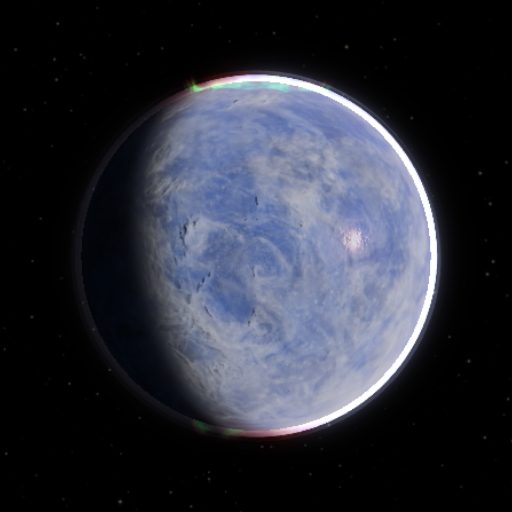
K2-3 d is the outermost of three small planets crossing in front of K2-3, a red dwarf about 144 light-years away. It orbits every 44.6 days and is about 1.5 times Earth's width. In 2015 the team that discovered it, led by Ian Crossfield, noted that it sits near the inner edge of the star's habitable zone, the range of distances where liquid water could last on a surface.
The system was found early in NASA's K2 mission, the second phase of the Kepler space telescope, and its bright star made it a prime target for weighing the planets. That has proved hard for K2-3 d. In 2019 a team led by Molly Kosiarek could not detect it in measurements of the star's wobble and set an upper limit of about 2.8 Earth masses. A 2022 study led by Hannah Diamond-Lowe also did not detect it, and suggested it may be less dense than a typical rocky super-Earth. In 2026 a team led by Avidaan Srivastava added ESPRESSO measurements spanning eight years of data and made a marginal detection, at about 2.1 Earth masses with a large uncertainty.
So its nature is still unclear: Srivastava's team described it as ambiguous, while its two inner siblings are probably rich in hydrogen and helium or other volatiles. An unusual feature of the system is that the planets get smaller with distance from the star, with K2-3 b the largest. Diamond-Lowe's team found that the usual explanations, in which starlight strips gas from the closest planets, do not readily account for this arrangement.