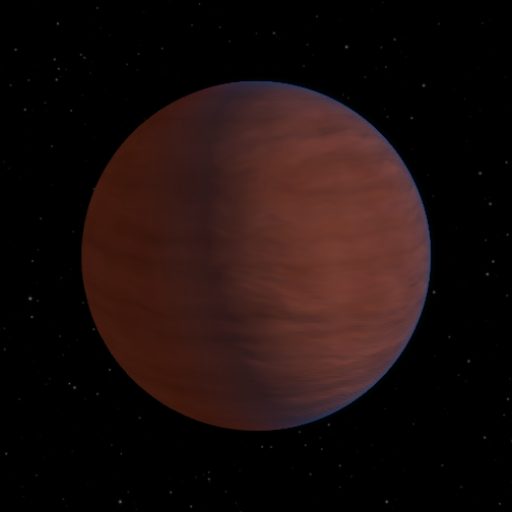
KELT-9 b
Also written KELT-9b, KELT 9b, KELT 9 b
- Mass
- 915.00 × Earth
- Radius
- 21.70 × Earth
- Gravity
- 1.94 g
- Surface (est.)
- 3,782 K
- Year
- 35.5 hrs
- From Earth
- 665 ly
- Mass
- 915.00 × Earth
- Radius
- 21.70 × Earth
- Gravity
- 1.94 g
- Surface (est.)
- 3,782 K
- Year
- 35.5 hrs
- From Earth
- 665 ly
KELT-9 system
- Type
- A-type (Blue-White)
- Spectral type
- A
- Temperature
- 9,270 K
- Radius
- 2.42 ☉
- Mass
- 2.32 ☉
- Planets
- 1
- Luminosity
- 38.9 ☉
Published by the NASA Exoplanet Archive. This world’s temperature and habitability score are computed from this star’s measured luminosity, not from a stand-in for its class.
 KELT-9 b0.034 AUYou are here915 M⊕
Star and planets drawn to scale: the star is 12 times as wide as KELT-9 b, so only its edge is in view. Orbits spaced as in the star system view.
On its day side, KELT-9 b is hotter than most stars. When its discovery was published in the journal Nature in 2017, it was the hottest giant planet known, with a day side of about 4,600 kelvin (roughly 4,300 °C). It was found by the KELT-North telescope at Winer Observatory in Arizona, part of the KELT survey run by Ohio State, Lehigh and Vanderbilt universities. The survey used the transit method: it spotted a small, regular dip in the star's light each time the planet passed in front of it.
Surface. No solid surface - thick gaseous envelope with possible rocky core deep within

Hydrogen and helium dominated with trace methane and ammonia
Hydrogen-rich atmosphere typical of gas giantsPhysical Properties
Time Dilation
Clocks run 27.7 seconds per year slower than deep space — about 37 minutes over a lifetimeElemental Composition
How TerraForge built this world
KELT-9 b, from the NASA Exoplanet Archive (found 2017). Measured: 915 Earth masses, 0.0337 AU, a 9270 K A-type star. Composition inferred from a mass of 915 Earths, which is giant territory whatever its 0.09x density suggests, with a day locked to its 1.5-day year, as anything orbiting this close would be.