Create your free account

Enter your email and we'll send a 6-digit code — no password needed.
We only keep your email and the username you choose. We never share or sell your email, and we don't send marketing — we use it only to email you a sign-in code. Read our privacy policy.
Planet profiles

KELT-9 b

Gas Giant · 665 light-years away · Last reviewed October 14, 2026

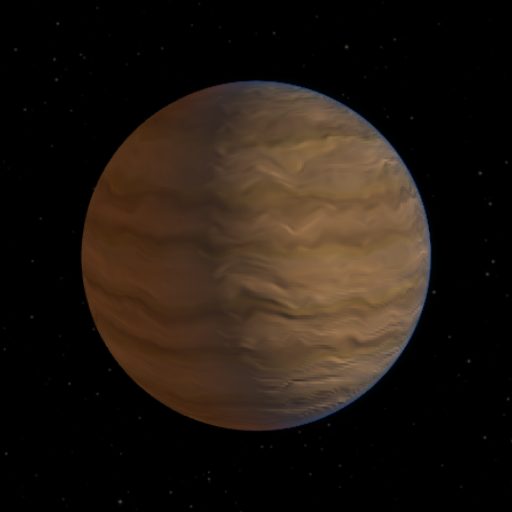
KELT-9 b rendered in TerraForge from its measured mass, orbit and star
TerraForge's rendering of KELT-9 b, generated by our physics engine from its measured mass, size, orbit and star. An illustration of what the science suggests, not a photograph.
TerraForge classification
Gas Giant
Host star
KELT-9 (A)
Distance
665 light-years
Orbit
1.48 days
Mass
915 × Earth
Radius
21.7 × Earth
Discovered
2017, transit

Figures from the NASA Exoplanet Archive. The classification is TerraForge’s, from its physics model.

On its day side, KELT-9 b is hotter than most stars. When its discovery was published in the journal Nature in 2017, it was the hottest giant planet known, with a day side of about 4,600 kelvin (roughly 4,300 °C). It was found by the KELT-North telescope at Winer Observatory in Arizona, part of the KELT survey run by Ohio State, Lehigh and Vanderbilt universities. The survey used the transit method: it spotted a small, regular dip in the star's light each time the planet passed in front of it.

The heat comes from its star. KELT-9 is a young, blue A-type star, nearly twice as hot as the Sun, and the planet circles it every 1.5 days. The planet is tidally locked, meaning one side always faces the star. Its orbit is also tipped so that it passes over the star's poles rather than around its equator. KELT-9 b has nearly three times Jupiter's mass but only about half its density, because the star's radiation has puffed up its atmosphere.

At these temperatures, molecules are broken apart into single atoms. In 2018 a team led by the University of Geneva used the HARPS-North spectrograph on the Telescopio Nazionale Galileo in La Palma to split the starlight passing through the planet's atmosphere into its colours. They found the fingerprints of iron and titanium vapour, including iron and titanium atoms that had lost an electron. Iron had never been detected in an exoplanet's atmosphere before. A separate 2018 study found hydrogen gas reaching out to about 1.64 times the planet's radius, close to the Roche lobe, the boundary beyond which the star's gravity pulls gas away. That points to a planet losing its atmosphere to space.

How fast it is losing gas, and what that means for its future, is still open. The discovery team suggested it could be largely stripped of its atmosphere over the star's lifetime. The Geneva team noted that it is massive enough to resist evaporating completely. Either way, the star is expected to swell into a red giant within a few hundred million years, which could swallow the planet.

TerraForge's model, working only from its mass, orbit and star, classifies KELT-9 b as a gas giant, which matches the observations. Its modelled temperature of 3,782 K sits close to the archive's whole-planet equilibrium temperature of 3,921 K, and below the roughly 4,600 K measured on the star-facing side.

Sources

  1. A giant planet undergoing extreme ultraviolet irradiation by its hot massive-star host — Nature (arXiv:1706.06723)
  2. Astronomers Find Planet Hotter Than Most Stars — NASA Jet Propulsion Laboratory
  3. Atomic iron and titanium in the atmosphere of the exoplanet KELT-9b — Nature (arXiv:1808.05653)
  4. Iron and titanium in the atmosphere of an exoplanet — University of Geneva
  5. An extended hydrogen envelope of the extremely hot giant exoplanet KELT-9b — Nature Astronomy (arXiv:1807.00869)
A banded gas giant with four moons in different colors: a yellow sulfur moon, two rust-red rock moons and a blue water moon

New: Choose What Your Moons Are Made Of 🌙

Every moon used to be grey rock, white ice or blue ocean, decided for you. Now each one has a "Made of" choice in the builder's Moons tab — silicate rock, iron, water ice, carbon, sulfur, or nitrogen and methane ice — and the physics decides what that becomes. Put water ice too close to the star and it boils off to bare rock. Put sulfur where a neighbouring moon keeps it tidally flexed and it erupts in Io's yellows. Give a Titan-sized moon nitrogen ice far from the sun and it wraps itself in haze. Hang a water moon about the mass of Earth off a giant planet in the habitable zone and it can hold air and open seas — scored for life on the same scale as a planet, with a day as long as its orbit. A tint slider nudges the colour, but only as far as that material could really go.

Create your free account

Enter your email and we'll send a 6-digit code — no password needed.
We only keep your email and the username you choose. We never share or sell your email, and we don't send marketing — we use it only to email you a sign-in code. Read our privacy policy.

Send feedback

We're still building out the best experience we can — and we'd love your input. Tell us about features you enjoy, ideas you'd like to see, or pain points where something feels off, and we'll know where to look next.

Type
Idea
Bug
Pain point
Other