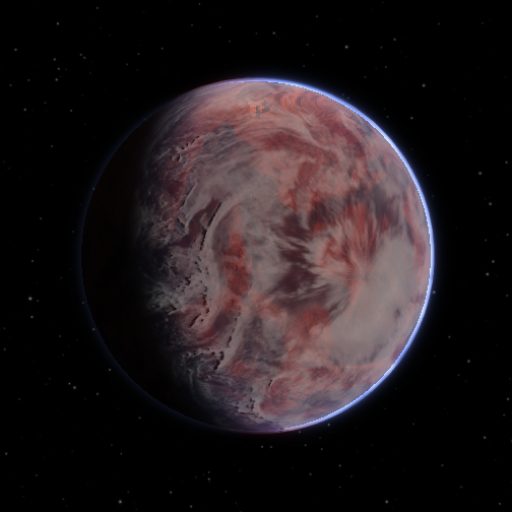
Kepler-1649 c
Also written Kepler-1649c, Kepler 1649c, Kepler 1649 c
- Mass
- 1.20 × Earth
- Radius
- 1.06 × Earth
- Gravity
- 1.07 g
- Surface (est.)
- 298 K
- Year
- 19.5 days
- From Earth
- 301 ly
- Mass
- 1.20 × Earth
- Radius
- 1.06 × Earth
- Gravity
- 1.07 g
- Surface (est.)
- 298 K
- Year
- 19.5 days
- From Earth
- 301 ly
Kepler-1649 system
- Type
- M-type (Red Dwarf)
- Temperature
- 3,240 K
- Radius
- 0.232 ☉
- Mass
- 0.198 ☉
- Planets
- 2
- Luminosity
- 5.16e-3 ☉
Published by the NASA Exoplanet Archive. This world’s temperature and habitability score are computed from this star’s measured luminosity, not from a stand-in for its class.
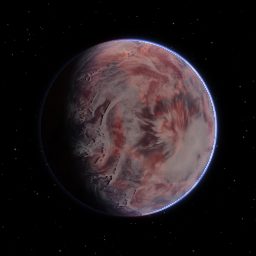 Kepler-1649 c0.065 AUYou are here1.2 M⊕
Star and planets drawn to scale: the star is 24 times as wide as Kepler-1649 c, so only its edge is in view. Orbits spaced as in the star system view.
Kepler-1649 c is an Earth-sized planet in its star's habitable zone that was almost missed. It is about 1.06 times Earth's width and orbits a small red dwarf about 300 light-years away every 19.5 days, receiving about three-quarters of the light Earth gets from the Sun. The habitable zone is the range of distances where a planet could keep liquid water on its surface, and the discovery team placed it firmly inside it.
Surface. Rocky surface with impact craters, possible volcanic features
✓ Conditions could support life. This planet’s modelled conditions could support biological processes: stable temperatures, liquid water and the chemistry life as we know it needs. That makes life possible, not present.


Thin CO₂ and nitrogen atmosphere
Nitrogen atmosphere provides protection but not breathable (partially stripped by slow rotation)Physical Properties
Elemental Composition
How TerraForge built this world
Kepler-1649 c, from the NASA Exoplanet Archive (found 2020). Measured: 1.2 Earth masses, 0.0649 AU, a 3240 K M-type star. Composition inferred from a measured bulk density of 1.01x Earth's, which is rock and iron, with a day locked to its 19.5-day year, as anything orbiting this close would be. Note: TerraForge comes out at 298 K against the archive's 234 K, because it models stars by spectral class, and Kepler-1649 is not an average M-type.