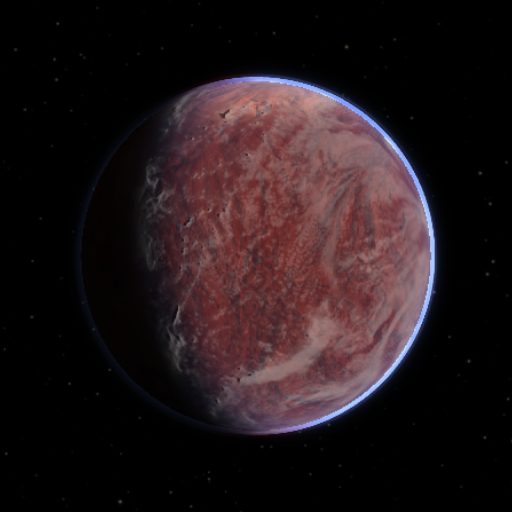
Kepler-1649 c is an Earth-sized planet in its star's habitable zone that was almost missed. It is about 1.06 times Earth's width and orbits a small red dwarf about 300 light-years away every 19.5 days, receiving about three-quarters of the light Earth gets from the Sun. The habitable zone is the range of distances where a planet could keep liquid water on its surface, and the discovery team placed it firmly inside it.
NASA's Kepler space telescope recorded its transits, the small dips in starlight as it crossed the star, but Kepler's automated software classified the signal as a false positive. In 2020 a team led by Andrew Vanderburg rescued it as part of a systematic visual check of every signal the software had rejected. They noted that the find shows the value of people looking at the data even as automated methods improve. The star also has an inner planet, Kepler-1649 b, which orbits every 8.7 days and is roughly like Venus in size and in the light it receives, so the system has a Venus-like and an Earth-like planet side by side.
How eccentric, or stretched, the planets' orbits are is poorly known. In 2021 a team led by Stephen Kane simulated the system and found that stretched orbits would make the planets' paths vary over cycles of 1,000 to 3,000 years. Their 3D climate models showed Kepler-1649 c could still keep a stable climate on its star-facing side through those changes. The discovery team estimated its equilibrium temperature at about 234 kelvin. Its mass has not been measured, and whether it has an atmosphere is unknown.